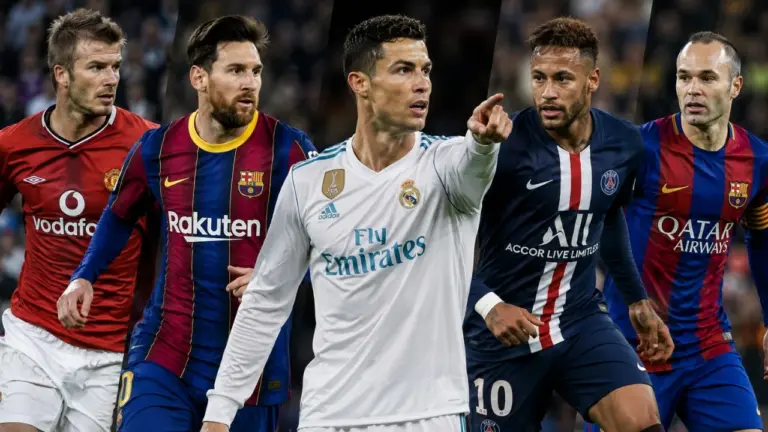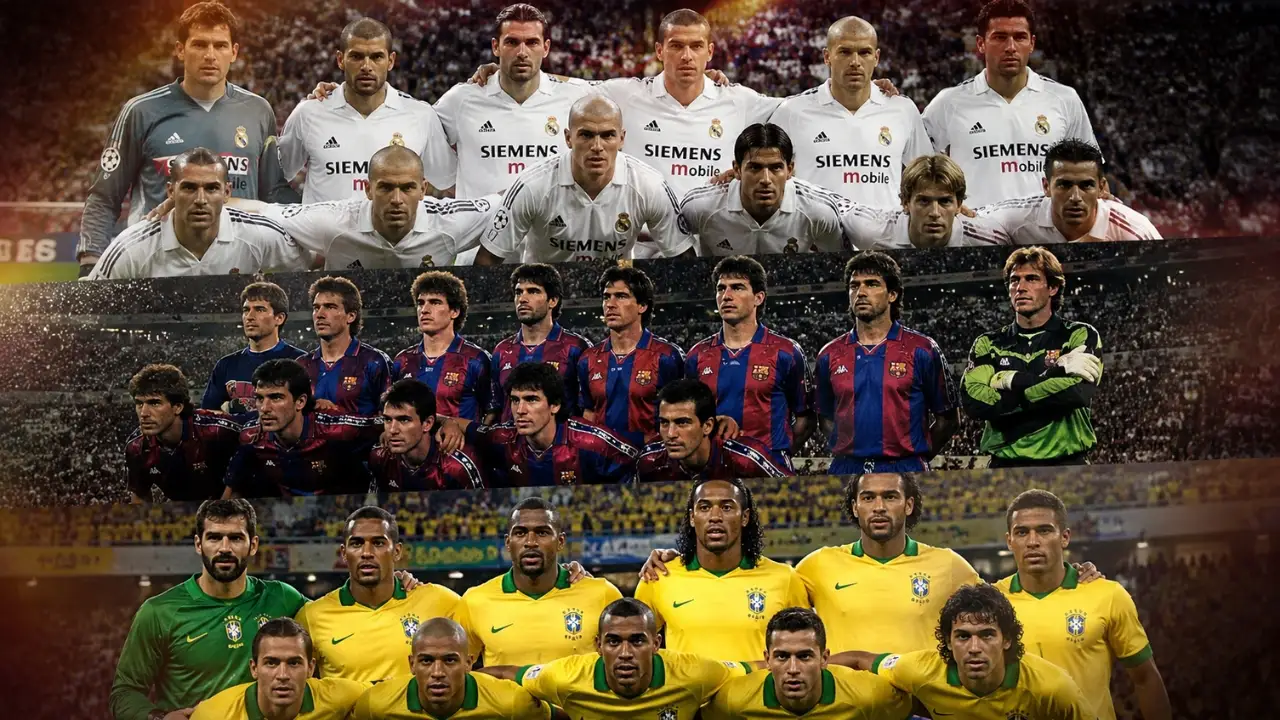
Football's most legendary teams ranked based on their achievements and influence on the sport.
Football has witnessed countless legendary teams, but only a select few have truly changed the sport forever. Some dominated Europe for years, others revolutionized tactics, while a handful inspired generations through unforgettable international triumphs. Greatness is measured not only by trophies but also by consistency, quality of opposition, playing style and the legacy left behind.
This ranking considers club and international teams from every era. Domestic titles, continental success, unbeaten seasons, tactical influence and historical significance have all been taken into account. While opinions will always differ, these 25 teams stand among the greatest ever assembled.
Top 25 Greatest Football Teams in History
| Rank | Team | Era | Greatest Achievement |
|---|---|---|---|
| 1 | Barcelona | 2008–11 | Tiki-taka dominance under Pep Guardiola |
| 2 | Real Madrid | 2016–18 | Three consecutive UEFA Champions League titles |
| 3 | Brazil | 1970 | Widely regarded as the greatest international team |
| 4 | AC Milan | 1988–94 | European dominance under Arrigo Sacchi |
| 5 | Ajax | 1971–73 | Total Football revolution |
| 6 | Bayern Munich | 2019–20 | Historic continental treble |
| 7 | Spain | 2008–12 | Three consecutive major international titles |
| 8 | Manchester United | 1998–99 | Historic continental treble |
| 9 | Liverpool | 1977–84 | European dynasty |
| 10 | Inter Milan | 2009–10 | Mourinho’s legendary treble winners |
| 11 | Manchester City | 2022–23 | Modern football perfection |
| 12 | Arsenal | 2003–04 | The Invincibles |
| 13 | France | 1998–2000 | World Cup and European champions |
| 14 | Germany | 2014 | World Cup-winning machine |
| 15 | Juventus | 1994–98 | European consistency |
| 16 | Chelsea | 2004–06 | Mourinho’s defensive dominance |
| 17 | Argentina | 2022 | World Cup champions |
| 18 | Brazil | 1982 | One of football’s greatest entertaining sides |
| 19 | Real Madrid | 1955–60 | Five straight European Cups |
| 20 | Benfica | 1960s | Eusébio’s golden generation |
| 21 | Celtic | 1966–67 | Lisbon Lions |
| 22 | Nottingham Forest | 1978–80 | Back-to-back European champions |
| 23 | Borussia Dortmund | 1996–97 | European champions |
| 24 | Netherlands | 1974 | Total Football pioneers |
| 25 | Hungary | 1950–54 | The Magical Magyars |
25. Hungary (1950–54)
Although Hungary never lifted the FIFA World Cup, the “Magical Magyars” transformed international football with their revolutionary style of play. Led by Ferenc Puskás, Sándor Kocsis and Nándor Hidegkuti, they dominated opponents through intelligent movement, technical excellence and tactical flexibility.
Their famous 6-3 victory over England at Wembley remains one of football’s most historic results. Despite falling short in the 1954 World Cup Final, Hungary’s influence on modern tactics remains enormous.
24. Netherlands (1974)
The Dutch national team that reached the 1974 FIFA World Cup Final is remembered for introducing Total Football to a global audience. Under Rinus Michels and inspired by Johan Cruyff, every player could interchange positions without disrupting the team’s structure.
Although they narrowly missed the World Cup trophy, their tactical innovation changed football forever and continues to influence coaches today.
23. Borussia Dortmund (1996–97)
Borussia Dortmund shocked Europe by defeating Juventus in the 1997 UEFA Champions League Final. Their disciplined defending, quick transitions and fearless mentality made them one of the continent’s toughest teams.
That squad demonstrated that teamwork and tactical discipline could overcome clubs with greater financial power.
22. Nottingham Forest (1978–80)
Brian Clough’s Nottingham Forest produced one of football’s greatest underdog stories. After earning promotion to England’s top division, Forest remarkably won back-to-back European Cups in 1979 and 1980.
Very few clubs have achieved so much in such a short period, making this team one of football’s most extraordinary success stories.
21. Celtic (1966–67)
Known as the “Lisbon Lions,” Celtic became the first British club to win the European Cup in 1967. Remarkably, every member of the starting lineup was born within a short distance of Glasgow.
Their attacking football, unity and historic achievement ensured their place among football’s greatest teams.
20. Benfica (1960s)
During the 1960s, Benfica established themselves as one of Europe’s dominant forces. Led by the legendary Eusébio, the Portuguese giants won multiple domestic titles and consecutive European Cups.
Their exciting attacking football helped Portuguese football gain worldwide recognition.
19. Real Madrid (1955–60)
The Real Madrid side led by Alfredo Di Stéfano, Ferenc Puskás and Francisco Gento laid the foundation for the club’s unmatched European legacy. Winning five consecutive European Cups remains one of football’s greatest achievements.
This team established Real Madrid as the benchmark for continental excellence.
18. Brazil (1982)
Although Brazil failed to win the World Cup, many fans still regard the 1982 squad as one of the greatest football teams ever assembled. Zico, Sócrates, Falcão and Éder produced breathtaking attacking football that captivated audiences worldwide.
Their style became a symbol of creativity and entertainment, proving that football greatness is not always measured solely by trophies.
17. Argentina (2022)
Lionel Messi finally completed football’s greatest story by leading Argentina to FIFA World Cup glory in Qatar. Lionel Scaloni built a balanced, disciplined team that combined defensive organization with attacking brilliance.
Their resilience under pressure and memorable performances throughout the tournament secured their place among football’s greatest international teams.
16. Chelsea (2004–06)
José Mourinho transformed Chelsea into one of Europe’s strongest teams almost immediately after arriving at Stamford Bridge. Built on defensive organization, tactical discipline and remarkable consistency, Chelsea dominated English football during this period.
Their record-breaking defensive performances and relentless winning mentality made them one of the Premier League’s greatest sides.
15. Juventus (1994–98)
Marcello Lippi’s Juventus consistently challenged for every major trophy in Europe during the mid-1990s. With stars such as Alessandro Del Piero, Didier Deschamps and Zinedine Zidane, Juventus combined technical quality with tactical intelligence.
Their consistency across domestic and European competitions earned them a place among football’s greatest teams.
14. Germany (2014)
Germany’s 2014 FIFA World Cup-winning team represented the perfect blend of tactical discipline, technical quality and squad depth. Under Joachim Löw, they dominated possession, pressed intelligently and consistently outperformed elite opposition.
Their unforgettable 7-1 victory over Brazil in the World Cup semi-final remains one of the most astonishing results in football history. Winning the tournament against Argentina completed one of the greatest World Cup campaigns ever produced.
13. France (1998–2000)
France became the dominant force in international football by winning the 1998 FIFA World Cup followed by UEFA Euro 2000. Led by Zinedine Zidane, Didier Deschamps, Thierry Henry and Patrick Vieira, the squad combined world-class talent with exceptional balance.
Strong defensively and clinical in attack, France set the standard for international football at the turn of the century.
12. Arsenal (2003–04)
Arsenal’s “Invincibles” achieved something no modern Premier League team has repeated—winning the entire league season unbeaten. Under Arsène Wenger, Arsenal combined technical brilliance with pace, physicality and remarkable consistency.
Featuring Thierry Henry, Dennis Bergkamp, Patrick Vieira and Robert Pirès, the team played exciting attacking football while maintaining incredible resilience throughout the campaign.
11. Manchester City (2022–23)
Pep Guardiola’s Manchester City completed one of the greatest seasons in club football history by winning the Premier League, FA Cup and UEFA Champions League.
Their positional play, relentless pressing and tactical flexibility overwhelmed opponents across every competition. With stars such as Erling Haaland, Kevin De Bruyne, Rodri and Bernardo Silva, City established themselves as one of football’s greatest modern teams.
10. Inter Milan (2009–10)
José Mourinho guided Inter Milan to a historic continental treble by winning Serie A, the Coppa Italia and the UEFA Champions League in a single season.
Built around defensive organization, tactical intelligence and devastating counterattacks, Inter defeated several of Europe’s strongest teams on their way to continental glory. Their famous Champions League semi-final victory over Barcelona remains one of football’s greatest tactical performances.
9. Liverpool (1977–84)
Liverpool dominated both English and European football during one of the most successful periods in the club’s history. Their consistency, winning mentality and remarkable squad depth helped them collect multiple league championships and European Cups.
With legendary players including Kenny Dalglish, Graeme Souness and Alan Hansen, Liverpool became the benchmark for sustained excellence throughout the late 1970s and early 1980s.
8. Manchester United (1998–99)
Sir Alex Ferguson’s Manchester United completed one of football’s most remarkable achievements by winning the Premier League, FA Cup and UEFA Champions League in the same season.
The dramatic Champions League Final comeback against Bayern Munich perfectly captured the resilience and belief that defined this legendary squad. Led by David Beckham, Roy Keane, Ryan Giggs and Dwight Yorke, United inspired a generation of football fans.
7. Spain (2008–12)
No international team has ever won three consecutive major tournaments quite like Spain. Between 2008 and 2012, they claimed two UEFA European Championships and the 2010 FIFA World Cup while redefining possession football.
With Xavi, Andrés Iniesta, Sergio Busquets, Iker Casillas and Xabi Alonso controlling matches through extraordinary technical ability, Spain dominated world football for four unforgettable years.
6. Bayern Munich (2019–20)
Bayern Munich produced one of the most dominant club seasons in football history during the 2019–20 campaign. Under Hansi Flick, they won every major competition they entered while playing aggressive, attacking football.
Their UEFA Champions League triumph, completed with a perfect winning record, showcased exceptional pressing, clinical finishing and tactical discipline. Robert Lewandowski, Thomas Müller, Manuel Neuer and Joshua Kimmich were central to one of Bayern’s finest-ever teams.
5. Ajax (1971–73)
Ajax revolutionized football through the philosophy of Total Football under Rinus Michels and later Ștefan Kovács. Johan Cruyff became the symbol of a team that emphasized movement, technical brilliance and tactical intelligence.
Winning three consecutive European Cups transformed Ajax into one of football’s most influential clubs, inspiring generations of coaches and players around the world.
4. AC Milan (1988–94)
Arrigo Sacchi and later Fabio Capello oversaw one of the strongest club teams football has ever seen. Featuring Franco Baresi, Paolo Maldini, Ruud Gullit, Marco van Basten and Frank Rijkaard, Milan combined defensive perfection with attacking brilliance.
Their tactical organization, pressing and dominance across Europe made them one of the greatest club sides of all time.
3. Brazil (1970)
Brazil’s 1970 FIFA World Cup-winning team is widely regarded as the greatest international side ever assembled. Pelé, Jairzinho, Tostão, Gérson and Carlos Alberto combined flair, creativity and technical excellence to produce football of the highest quality.
Their performances in Mexico inspired generations of footballers and established Brazil as the global symbol of beautiful football.
2. Real Madrid (2016–18)
Zinedine Zidane’s Real Madrid achieved something no club had accomplished in the modern UEFA Champions League era by winning three consecutive titles.
Cristiano Ronaldo, Luka Modrić, Toni Kroos, Sergio Ramos, Marcelo and Karim Benzema formed the backbone of a team that repeatedly delivered under the greatest pressure. Their consistency in Europe’s biggest competition secures their place among football’s greatest club teams.
1. Barcelona (2008–11)
Based on trophies, tactical influence, sustained dominance and historical impact, Pep Guardiola’s Barcelona ranks first in this editorial list of the greatest football teams in history. Their possession-based philosophy, known globally as tiki-taka, revolutionized modern football and influenced countless coaches across every level of the game.
With Lionel Messi at the peak of his powers alongside Xavi Hernández, Andrés Iniesta, Sergio Busquets, Dani Alves, Gerard Piqué and Carles Puyol, Barcelona dominated through technical excellence, intelligent movement and relentless pressing.
Many of the legends who inspired football’s greatest teams also feature in our ranking of the best football players in the world right now, highlighting today’s stars shaping the modern game.
Winning multiple La Liga titles and two UEFA Champions League trophies while consistently outperforming elite opposition cemented their legacy. Beyond the trophies, this Barcelona side permanently changed how football is played and remains the benchmark against which every great team is measured.
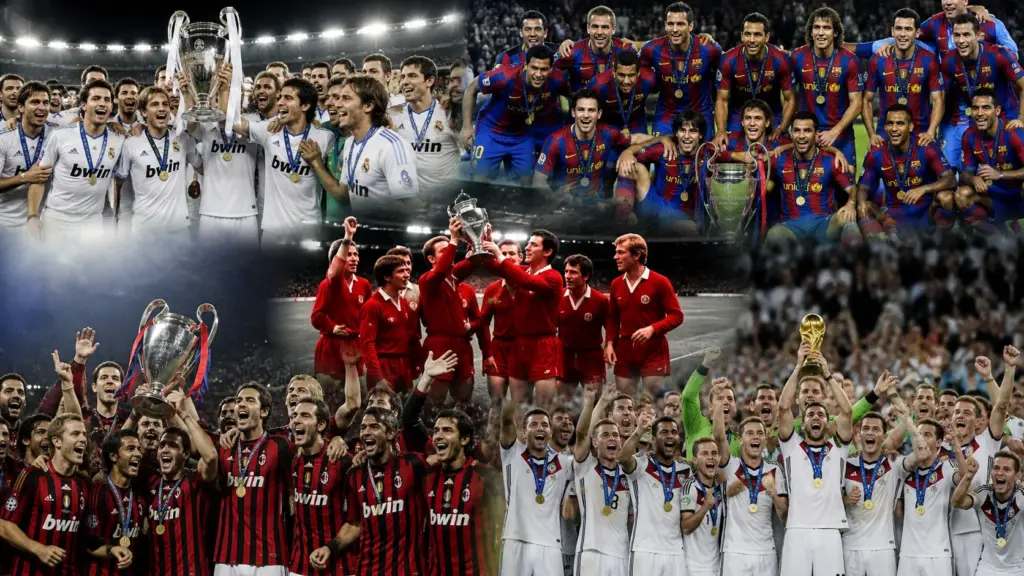
Final Verdict
Football history has produced countless legendary teams, but only a select few have changed the sport forever. Whether through tactical innovation, sustained dominance or unforgettable achievements, these sides left a legacy that continues to influence modern football.
From Hungary’s revolutionary style and Ajax’s Total Football to Barcelona’s tiki-taka masterpiece and Real Madrid’s unprecedented Champions League dominance, each team on this list earned its place through excellence rather than reputation alone. While debates about the greatest team will always continue, these 25 sides represent the highest standards football has ever reached.
Frequently Asked Questions
Which is the greatest football team of all time?
Based on this editorial ranking, Pep Guardiola’s Barcelona (2008–11) ranks first thanks to its tactical innovation, sustained success and lasting influence on modern football.
Which international team ranks highest?
Brazil’s 1970 FIFA World Cup-winning team is the highest-ranked international side thanks to its legendary players and iconic performances.
Why isn’t Real Madrid ranked first?
Although Real Madrid’s three consecutive UEFA Champions League titles were extraordinary, Barcelona’s overall style of play, tactical influence and dominance between 2008 and 2011 gave them a slightly greater historical impact.
Are both club and international teams included?
Yes. This ranking combines the greatest club and national teams based on trophies, dominance, legacy, tactical innovation and long-term influence.
What factors were considered for the rankings?
The rankings consider major trophies, consistency, quality of opposition, tactical impact, historical significance, iconic players and influence on football history.
Sources Used
- FIFA
- UEFA
- Official club websites
- Official competition records
- Historical football archives
- RSSSF (Rec.Sport.Soccer Statistics Foundation)
About the Author