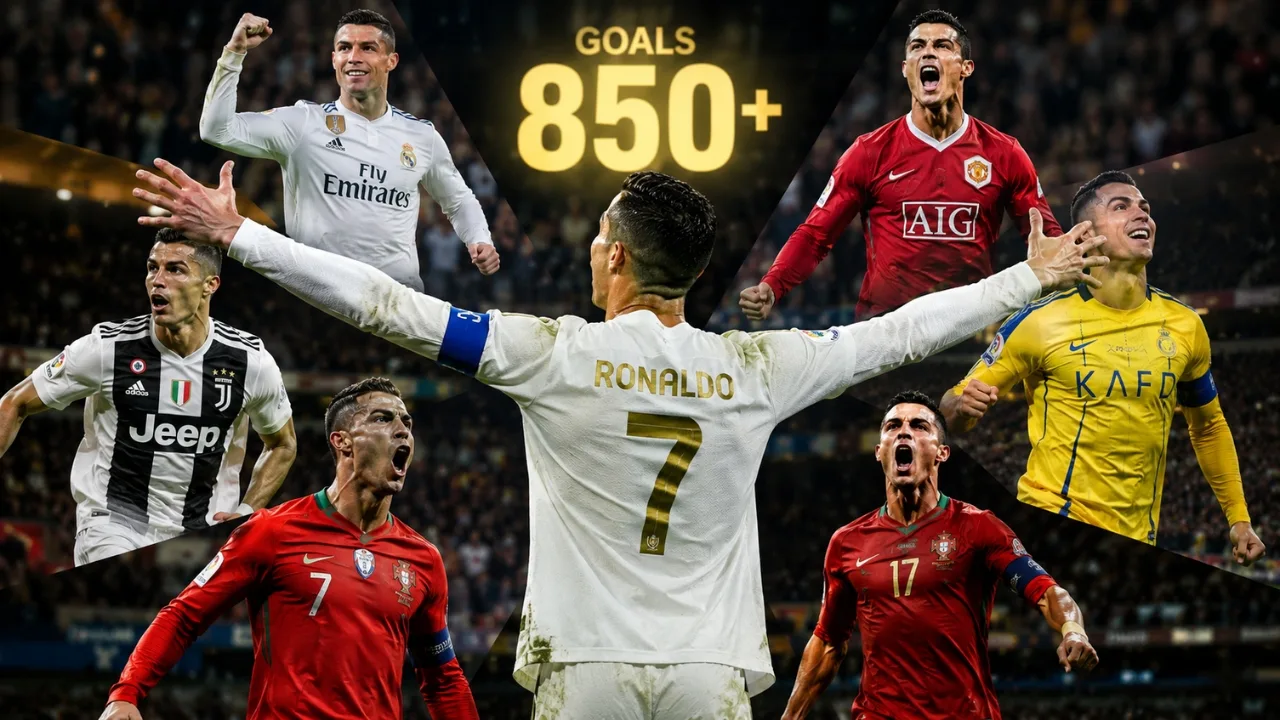
Cristiano Ronaldo leads football's documented all-time top-level goalscoring records.
Cristiano Ronaldo leads the IFFHS all-time ranking for top-level goals in men’s football. The Portugal captain has spent more than two decades building a scoring record across Sporting CP, Manchester United, Real Madrid, Juventus, Al Nassr and his national team. Yet answering the question is not as simple as comparing one number. Historical records differ over which matches count, particularly for Pelé, Romário and Josef Bican, so understanding the distinction between official top-level goals and broader career totals matters.
Quick Answer: Who Is Football’s All-Time Top Scorer?
Under IFFHS’s top-level methodology, Cristiano Ronaldo is the leading scorer in men’s football history. The International Federation of Football History & Statistics (IFFHS) places Ronaldo first in its historical ranking, ahead of Lionel Messi and the great scorers of previous generations.
Ronaldo’s total is still changing because he remains active. UEFA’s July 20, 2026 update lists Ronaldo with a men’s world-record 146 international goals in 233 appearances for Portugal.
That distinction is important. Career totals combine recognized senior club and international goals, while international records count only appearances for a player’s national team.
Who Are the Highest Goalscorers in Football History?
Historical comparisons need some caution because record-keeping standards have changed enormously since the early decades of organized football.
IFFHS publishes historical rankings based on top-level matches and had Ronaldo at No. 1 when he became the first player in its records to reach 900 top-level goals in September 2024. Lionel Messi was second.
Rather than mixing constantly changing totals for active players with disputed historical figures, the clearest comparison is their position and scoring legacy.
| Player | Nation | Historical significance |
|---|---|---|
| Cristiano Ronaldo | Portugal | No. 1 in IFFHS top-level goals ranking |
| Lionel Messi | Argentina | Ronaldo’s closest active historical rival |
| Josef Bican | Austria/Czechoslovakia | FIFA credits him with an estimated 805 career goals |
| Romário | Brazil | Among the most prolific documented scorers in football history |
| Pelé | Brazil | Historic Santos and Brazil goalscorer |
| Ferenc Puskás | Hungary/Spain | Prolific scorer for club and country |
The exact order below Ronaldo and Messi can vary depending on the statistical methodology being used. That is why claims involving historical goal totals should always explain what types of matches are included.
Why Cristiano Ronaldo Holds the Record
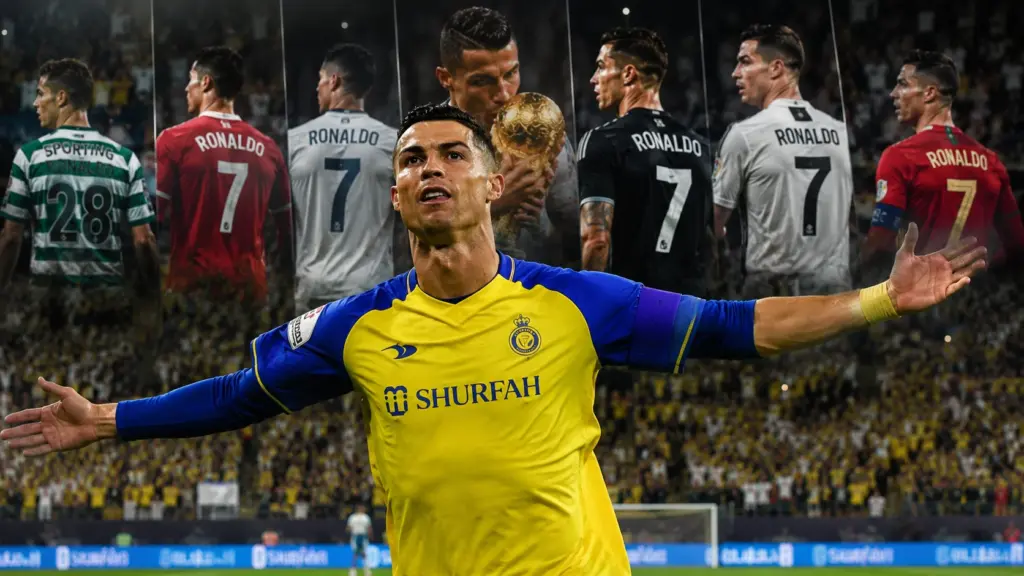
Ronaldo’s record is remarkable not simply because of the final number, but because of where and how those goals were accumulated.
His senior career began at Sporting CP before a move to Manchester United in 2003. He subsequently became Real Madrid’s record scorer, played for Juventus, returned to Manchester United and later joined Al Nassr in Saudi Arabia.
Across that journey, Ronaldo evolved from a wide attacker known for dribbling and acceleration into a forward whose game increasingly centered on movement, finishing and penalty-area positioning.
In March 2026, FIFA described Ronaldo as closing in on 1,000 career goals, highlighting the extraordinary longevity behind his scoring record.
Ronaldo’s International Record Adds Another Dimension
Club goals tell only part of the story.
Ronaldo made his Portugal debut in 2003 and eventually passed Iran’s Ali Daei to become the leading goalscorer in men’s international football. UEFA recorded Ronaldo at 146 Portugal goals from 233 appearances as of July 12, 2026. Messi was second on UEFA’s list with 125 goals for Argentina, while Daei’s 108 remained the benchmark among retired players.
At the 2026 FIFA World Cup, Ronaldo became the first male player to score at six different World Cup final tournaments, extending a run that began in 2006.
Few scoring records demonstrate longevity quite as clearly.
Lionel Messi Remains Ronaldo’s Closest Modern Rival
Any discussion of Ronaldo’s record naturally leads to Lionel Messi.
Their careers have overlapped for more than two decades, producing a scoring rivalry unprecedented in the modern game. While Ronaldo leads the historical top-level total, Messi has built his own extraordinary record with Barcelona, Paris Saint-Germain, Inter Miami and Argentina.
The difference between them cannot be reduced to goals alone. Messi has operated extensively as a creator as well as a scorer, while Ronaldo’s career evolution increasingly pushed him toward being the focal point of the attack.
That creative side of Messi’s game is an important part of why judging his career purely through goals gives an incomplete picture. His ability to create for teammates also places him prominently among the football players with the most assists of all time.
For the specific question of who has scored the most recognized top-level goals, however, Ronaldo remains ahead.
What About Josef Bican?
Josef Bican is central to any serious discussion of football’s historical scoring records.
The Austrian-born striker played between the 1930s and 1950s and was extraordinarily prolific. FIFA has described Bican as one of football’s all-time leading marksmen and cited an estimated 805 goals during his career from 1931 to 1955. FIFA also noted a club scoring rate of 1.52 goals per game.
Bican’s case demonstrates why historical goal rankings can become complicated.
Football in his era did not have today’s standardized digital databases. Different statistical organizations can classify wartime competitions, regional matches and other fixtures differently. As a result, totals associated with Bican can vary depending on the methodology.
That does not diminish Bican’s achievements; it means his totals should be compared with modern records only when the same counting criteria are applied.
Why Do Pelé’s Goal Totals Vary?
Pelé presents another famous example.
Some career totals associated with the Brazilian legend include friendlies and exhibition matches played by Santos during an era when international club tours were a significant part of the football calendar.
Those goals remain part of Pelé’s career record, but historical rankings may separate them from totals limited to top-level competitive matches.
The distinction explains why supporters may encounter different figures when searching for Pelé’s career goals. It is usually a difference in counting methodology rather than evidence that one side has discovered hundreds of previously unknown goals.
Did Romário Score More Than 1,000 Goals?
Romário famously celebrated reaching 1,000 career goals in 2007, but that figure used a broader definition than the official/top-level totals commonly employed in historical rankings.
IFFHS’s historical club ranking, for example, listed Romário with 692 top-level club goals in its May 2024 update. Ronaldo led that particular club-only ranking with 763, followed by Messi with 727.
This is another reason the phrase “official goals” requires context. A player’s broader career tally and a statistical organization’s top-level tally are not necessarily measuring the same thing.
Official Goals vs. Unofficial Goals
This distinction is the source of much of the confusion surrounding football’s scoring record.
Competitive and Recognized Top-Level Goals
Historical databases generally build comparable records from senior matches recognized within their methodology, including domestic leagues and cups, international club competitions and senior national-team fixtures.
These records make comparisons across generations more practical.
Friendlies and Other Historical Matches
Older clubs frequently played tours, exhibitions and other fixtures that carried far greater sporting importance than many modern friendlies.
A goal scored in such a match remains part of a player’s football history, but including it in an all-time competitive scoring ranking can create an uneven comparison with players whose careers occurred under different schedules and record-keeping standards.
That is why reputable historical rankings define their criteria rather than simply selecting the largest number attached to each player.
How Ronaldo’s Record Changed the All-Time Debate
Ronaldo did not merely pass a historical benchmark and retire. He continued adding to it.
IFFHS recorded him at 834 top-level goals in March 2023 and 902 by September 2024. FIFA was describing him as approaching the 1,000-goal milestone by March 2026.
His longevity is particularly unusual because the record spans dramatically different stages of his career: emerging winger, elite wide forward, devastating central attacker and veteran goalscorer.
The record also covers several football environments. He scored in Portugal, England, Spain, Italy and Saudi Arabia while simultaneously establishing the men’s international scoring record with Portugal.
The 1,000-Goal Question
One of the next major milestones surrounding Ronaldo’s career is the 1,000-goal mark. FIFA described him as closing in on that total in March 2026, although any eventual 1,000-goal claim should still identify the counting methodology being used.
Whether he reaches that mark depends on how long he continues playing and which statistical definition is being used. For record purposes, any claim that Ronaldo has reached 1,000 should specify the counting methodology rather than mixing competitive records with friendlies or other categories.
The same standard should apply to every player in the historical debate.
Common Misconceptions About Football’s All-Time Goals Record
The biggest source of confusion is not the identity of the leader. It is what people mean when they say “career goals.”
“Pelé Scored More Than 1,000 Goals, So He Must Be First”
Pelé’s broader career totals often included friendlies, exhibitions and tour matches for Santos. Those games were genuine parts of his career, but they are not necessarily counted in statistical rankings limited to top-level competitive football.
IFFHS, for example, listed Pelé with 679 top-level club goals in its historical club ranking published in 2024. That methodology is different from broader totals traditionally associated with his career.
Both figures can describe aspects of Pelé’s career, but they should not be presented as if they measure the same thing.
“Romário Reached 1,000, So Ronaldo Didn’t Break the Record”
Romário’s celebrated 1,000-goal milestone used a broader count that included matches outside the narrower top-level methodology used by organizations such as IFFHS.
In IFFHS’s May 2024 club-goals ranking, Romário was credited with 692 top-level club goals, behind Ronaldo and Messi.
The disagreement is therefore about classification, not whether Romário was an exceptional scorer.
“Ronaldo’s International Record Is His Career Record”
These are separate achievements.
Ronaldo’s career total combines his recognized senior club and Portugal goals. His international record includes only goals scored for Portugal.
UEFA listed Ronaldo at 146 goals in 233 Portugal appearances as of July 20, 2026, making him the leading scorer in men’s international football. Lionel Messi followed with 125 goals, while Ali Daei was third with 108.
Ronaldo vs. Messi: Who Has Scored More Goals?
Ronaldo leads Messi in total top-level career goals.
IFFHS’s September 2024 historical update recorded Ronaldo at 902 top-level goals and placed him first in its all-time ranking. Messi occupied second place.
That gap has changed because both players have continued playing, so older articles quoting exact career totals can become outdated quickly.
Their international records provide another direct comparison. UEFA’s July 2026 data lists Ronaldo with 146 goals for Portugal and Messi with 125 for Argentina.
The scoring comparison does not settle the broader Ronaldo-versus-Messi debate. Goals are only one part of evaluating two careers that also include chance creation, trophies, individual awards, longevity and performances across different competitions.
For the narrower question asked here, however, the answer is clear: Ronaldo has scored more top-level career goals.
How Extraordinary Is Ronaldo’s International Scoring Record?
Ronaldo’s Portugal numbers deserve separate attention because international football offers far fewer matches than club football.
UEFA records his 146 goals across 233 appearances. He broke the previous men’s international scoring record in September 2021 when he scored twice against the Republic of Ireland, moving beyond Ali Daei’s benchmark.
His scoring has also stretched across generations of Portugal teams. UEFA notes that Ronaldo has scored for his country in 23 consecutive calendar years from 2004 through 2026, another men’s world record.
That longevity helps explain how he has built a total that would once have seemed unreachable.
Why Comparing Goals Across Eras Is Difficult
A simple leaderboard can hide enormous differences between football eras.
Bican played much of his career during the first half of the 20th century. Pelé’s Santos traveled extensively for lucrative international exhibitions. Ronaldo and Messi have played in an era where elite clubs contest large numbers of domestic, continental and international fixtures under far more standardized record keeping.
Competition structures, schedules, substitutions, tactical systems, travel and the documentation of matches have all changed.
There is another complication: not every historical competition is classified identically by every statistics organization.
IFFHS itself leaves some prolific historical scorers unranked in certain tables because much of their scoring occurred in regional competitions it does not classify at the required level.
That is why a credible all-time goals list needs a defined methodology.
What Is the Best Way to Compare Football’s Greatest Goalscorers?
There is no single statistic that completely measures goalscoring greatness.
Career goals measure volume and longevity. Goals per game can highlight efficiency. International goals show production in a very different environment. Champions League or domestic league totals reveal performance within specific competitions.
Context matters as well.
Ronaldo’s case combines elite scoring with exceptional longevity across several major leagues and international football. Messi combines enormous scoring output with an unusually influential creative role. Pelé and Bican dominated periods with different competition structures, while Puskás and Romário produced scoring records that remain remarkable decades later.
A ranking can answer who scored the most under a particular methodology. It cannot completely explain how great each scorer was.
Key Takeaways
- Cristiano Ronaldo is the leading men’s goalscorer in IFFHS’s historical top-level ranking.
- Ronaldo became the first player in IFFHS records to reach 900 top-level goals in September 2024.
- Exact career totals for active players change as they continue playing.
- UEFA listed Ronaldo with a men’s international record of 146 goals for Portugal as of July 20, 2026.
- Lionel Messi remains Ronaldo’s closest modern rival in the historical scoring race.
- Pelé, Romário and Josef Bican can have different totals depending on which competitions and matches a statistical source includes.
- “Official,” “top-level” and broader career goal totals should not be treated as interchangeable terms.
Final Thoughts
So, who has scored the most goals in football history?
Using IFFHS’s top-level methodology, the answer is Cristiano Ronaldo.
His record has been built across more than two decades of senior football, spanning multiple countries, competitions and dramatically different phases of his career. His 146 Portugal goals also give him the men’s international scoring record, adding another historic benchmark to his résumé.
The historical debate becomes less straightforward below Ronaldo because older scoring records were compiled under different conditions. Pelé, Josef Bican, Romário and Ferenc Puskás belong in any discussion of football’s greatest goalscorers, but comparing their totals requires consistent criteria.
Ronaldo’s advantage is that his career has unfolded during an era of detailed record keeping, and his position at the top of IFFHS’s documented top-level ranking is clear.
FAQ
Who has scored the most goals in football history?
Cristiano Ronaldo leads the IFFHS historical ranking for top-level men’s football goals. He became the first player to reach 900 under that methodology in September 2024 and has continued playing since.
How many international goals has Cristiano Ronaldo scored?
UEFA recorded Ronaldo at 146 goals in 233 appearances for Portugal as of July 20, 2026. He holds the men’s world record for international goals.
Who has more goals, Ronaldo or Messi?
Cristiano Ronaldo has more top-level career goals than Lionel Messi. IFFHS ranks Ronaldo ahead of Messi in its historical goalscoring records.
Did Pelé score 1,000 goals?
Career figures exceeding 1,000 associated with Pelé use a broader counting method that includes matches such as club friendlies and exhibitions. Historical rankings limited to top-level matches produce a lower total, so the criteria need to be stated whenever the figure is discussed.
Did Romário score 1,000 goals?
Romário celebrated what he considered his 1,000th career goal in 2007, but that tally used a broader methodology than top-level statistical rankings. IFFHS listed him with 692 top-level club goals in its May 2024 historical club ranking.
Who has scored the most international goals in men’s football?
Cristiano Ronaldo. UEFA lists him first with 146 Portugal goals, ahead of Lionel Messi with 125 and Ali Daei with 108 in its July 2026 ranking.
Why are historical football goal totals disputed?
Different sources classify friendlies, exhibitions, regional competitions and some historical matches differently. Record keeping was also less standardized during earlier eras, making consistent comparisons more difficult.
Sources
- UEFA — Cristiano Ronaldo’s 146 Portugal Goals
- IFFHS — All-Time Goal Scorers Ranking
- IFFHS — All-Time Club Goal Scorers Ranking
- UEFA — Cristiano Ronaldo: All-Time Leading Scorer in Men’s International Football
About the Author

2 thoughts on “Who Has Scored the Most Goals in Football History?”