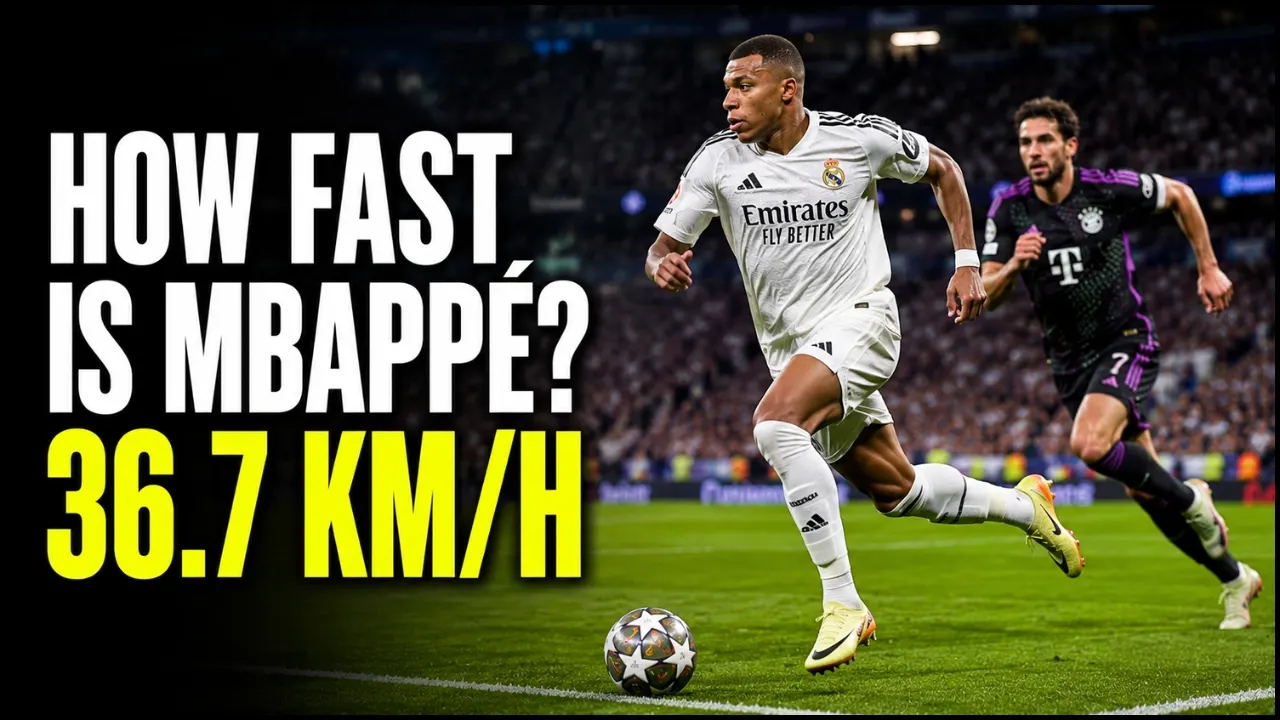
Kylian Mbappé's explosive acceleration and top speed make him one of football's most dangerous runners.
Kylian Mbappé’s speed has influenced how defenders approach him throughout his career. The Real Madrid and France forward can turn open grass into a scoring opportunity within seconds, but the numbers attached to his pace are often confused online. Depending on the competition and tracking system, different top speeds have been reported. Official UEFA data provides some of the clearest evidence: Mbappé reached 36.7 km/h (22.8 mph) at UEFA Euro 2024, the fastest speed recorded by any player at that tournament.
Quick Answer: How Fast Is Kylian Mbappé?
Mbappé has been officially tracked at 36.7 km/h (22.8 mph) by UEFA during Euro 2024. That is one of the strongest verified benchmarks for his top speed because it comes directly from UEFA’s tournament physical analysis.
Other legitimate measurements vary. UEFA recorded him at 35.6 km/h (22.1 mph) in the 2022/23 Champions League, while UEFA’s current European Qualifiers statistics list a peak of 36.23 km/h (22.5 mph).
| Measurement | Speed | Source |
|---|---|---|
| Euro 2024 top speed | 36.7 km/h / 22.8 mph | UEFA |
| 2026 European Qualifiers | 36.23 km/h / 22.5 mph | UEFA |
| 2022/23 Champions League | 35.6 km/h / 22.1 mph | UEFA |
These figures should not be treated as contradictory. A player’s recorded maximum changes from match to match depending on the situation, distance available to accelerate, fatigue, positioning and the tracking methodology used by a competition.
Mbappé’s 36.7 km/h Euro 2024 Sprint
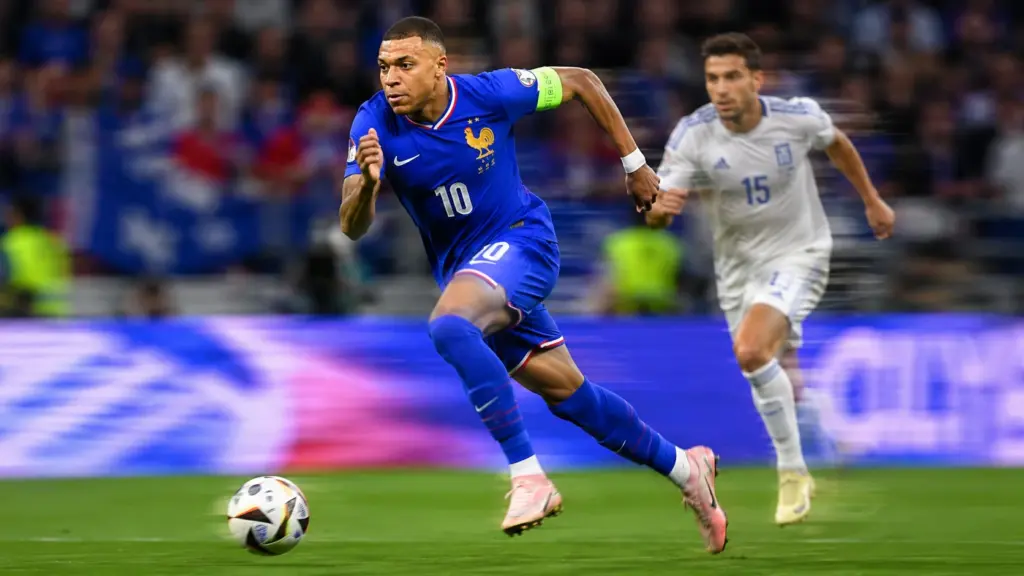
The clearest answer to the Mbappé speed question comes from UEFA’s physical analysis of Euro 2024.
UEFA recorded Mbappé at 36.7 km/h, making him the tournament’s fastest player. Nico Williams of Spain, Micky van de Ven of the Netherlands and Benjamin Šeško of Slovenia shared the next-highest mark at 35.9 km/h.
Mbappé wasn’t merely fast by attacking-player standards; UEFA’s data gave him the highest recorded top speed of the tournament.
UEFA’s analysis also provides useful context for why those bursts matter. High-speed running accounts for only a relatively small part of the total distance players cover, but sprinting can be decisive in critical match actions.
That description fits Mbappé particularly well. He doesn’t need to sprint continuously to influence a game. The threat comes from choosing the right moment and accelerating into a space a defender cannot recover.
Did Kylian Mbappé Really Reach 38 km/h?
This is where discussions about Mbappé’s “record” become less straightforward.
A 38 km/h (23.6 mph) figure has circulated widely in football coverage and online comparisons. However, it should not be presented as his definitive official career record without identifying the specific tracking source and methodology behind the measurement.
For a reliable benchmark, UEFA’s 36.7 km/h Euro 2024 figure is much easier to verify because UEFA published the tournament’s physical-performance data directly.
There is also strong evidence of Mbappé reaching roughly 37 km/h much earlier in his career. FIFA’s retrospective coverage of France’s famous 4-3 victory over Argentina at the 2018 World Cup includes teammate Florian Thauvin recalling that Mbappé was clocked at 37 km/h during the match.
The distinction matters because a widely reported figure, a teammate’s recollection of tracking data, and an official tournament-wide physical analysis are different types of evidence.
Mbappé’s Verified Speed Measurements
Looking across different competitions gives a better picture than relying on a single viral number.
In the 2022/23 Champions League, UEFA measured Mbappé at 35.6 km/h. That was still an elite sprint speed, although it placed him joint 11th in UEFA’s ranking for that Champions League season. Mykhailo Mudryk and Ousmane Dembélé were both recorded at 36.6 km/h.
Two years later, Mbappé reached 36.7 km/h at Euro 2024, demonstrating that his elite pace remained a major weapon. UEFA’s European Qualifiers data has since recorded a top speed of 36.23 km/h.
The broader takeaway is more useful than declaring one universal record: Mbappé has repeatedly demonstrated mid-to-high 30 km/h sprint speed in official elite competition.
Why Mbappé Looks Even Faster With the Ball
Raw maximum speed only explains part of what makes Mbappé difficult to defend.
Plenty of elite footballers can produce exceptional sprint numbers. Mbappé combines that pace with timing, control and an ability to accelerate during attacking actions.
Acceleration Creates the Separation
A forward rarely gets 60 or 80 meters of clear field to build toward maximum velocity. Most decisive attacking races happen over much shorter distances.
That makes acceleration crucial.
Mbappé can create separation rapidly after turning toward goal or attacking space behind a defensive line. The defender may have only a moment to react, and once Mbappé establishes momentum, recovering becomes extremely difficult.
Defenders Have to Respect the Space Behind Them
His speed changes games even when he doesn’t receive the ball.
UEFA’s technical analysis of Paris Saint-Germain’s 2024 Champions League victory at Real Sociedad highlighted precisely this problem. UEFA match observer Claude Makélélé noted Mbappé’s pace and positioning, while the analysis explained that Real Sociedad’s defenders were wary of pushing their line too high and leaving space behind.
That creates a tactical dilemma.
Step forward aggressively and Mbappé can attack the space behind. Drop deeper to protect against the run and more room can appear between midfield and defense.
Speed, in that sense, becomes a tactical weapon before the sprint even starts.
A Champions League Example of Mbappé’s Pace
Paris Saint-Germain’s Champions League round-of-16 second leg against Real Sociedad in March 2024 provided a clear example.
For Mbappé’s opening goal, UEFA described him turning his marker, racing onto Ousmane Dembélé’s pass and producing an explosive acceleration before creating space to finish from a tight angle. He later scored again as PSG won 2-1 on the night and 4-1 on aggregate.
That sequence captures why a stopwatch alone cannot fully describe his threat.
The key isn’t simply reaching a high top speed. It’s accelerating at the moment a defensive structure becomes vulnerable.
How Mbappé’s Speed Fits His Game at Real Madrid
Mbappé’s role has never depended exclusively on winning straight-line races.
At Real Madrid, Mbappé’s pace remains part of a broader attacking package built around finishing, movement, and the ability to exploit space. His speed is most dangerous when those qualities combine, rather than when he is simply running in a straight line.
Those numbers aren’t speed statistics, but they provide useful context.
Mbappé’s pace is most dangerous because it sits alongside finishing, off-ball movement and the ability to attack from different starting positions. A defender cannot simply protect the space behind and assume the problem is solved.
Is Mbappé the Fastest Footballer in the World?
Calling any player the definitive “fastest footballer in the world” is difficult.
Tracking data comes from different competitions, seasons and measurement systems. Players also need the right match situation to reach maximum velocity. A forward who never gets a long open-field sprint may have a lower recorded top speed than his actual physical ceiling.
Mbappé’s own Champions League data proves the point. His 35.6 km/h mark in 2022/23 was exceptional, yet ten players in UEFA’s ranking had reached a higher speed at that stage of the competition.
At Euro 2024, however, nobody was faster: Mbappé’s 36.7 km/h led the tournament.
The evidence supports describing Mbappé as one of elite football’s fastest players, but not as the holder of an uncontested world speed record.
That distinction becomes clearer when Mbappé is compared with the fastest football players still active in 2026, where recorded match speeds provide a better basis for comparison than reputation alone.
Mbappé vs. Usain Bolt: Why the Comparison Is Misleading
Comparisons between Mbappé and Usain Bolt are popular, but they measure very different athletic tasks.
Bolt’s world-record 100-meter performance came on a straight track from starting blocks, without a ball, opponents or tactical decisions. Football players accelerate repeatedly from different positions, change direction and often sprint while controlling the ball.
UEFA has noted that Bolt reached approximately 44.7 km/h during his world-record run, substantially higher than Mbappé’s official Euro 2024 maximum of 36.7 km/h.
Mbappé is extraordinarily fast for an elite footballer. That does not make his football sprint directly comparable with the fastest 100-meter sprinter in history.
Within football itself, the more relevant question is how Mbappé’s verified pace compares with the sport’s historical extremes. Looking at the evidence behind the fastest football player ever and the official speed record provides a much more meaningful benchmark than comparing a football sprint with Bolt’s 100-meter performance.
Common Misconceptions About Mbappé’s Speed
The biggest misconception is that Mbappé has one permanent “top speed.”
Recorded top speed is an observed match statistic, not necessarily the absolute maximum velocity an athlete could ever produce under ideal conditions. His UEFA measurements have varied across competitions because match circumstances vary.
Another mistake is treating every number published online as equally authoritative. Figures from official tracking systems should carry more weight than numbers repeated without a clear primary source.
Finally, maximum speed should not be confused with acceleration. For football, the ability to create separation over a short distance can matter more than who posts the highest isolated peak velocity.
Key Takeaways
- UEFA officially measured Mbappé at 36.7 km/h (22.8 mph) at Euro 2024.
- That was the fastest speed recorded at the tournament.
- UEFA recorded him at 35.6 km/h during the 2022/23 Champions League.
- Current UEFA European Qualifiers data lists a 36.23 km/h peak.
- FIFA has documented a teammate’s account that Mbappé was clocked at 37 km/h against Argentina at the 2018 World Cup.
- The widely repeated 38 km/h claim should not be treated as his definitive official record without a clear primary tracking source.
- His acceleration, movement and ability to exploit space are as important as his maximum velocity.
Final Thoughts
Kylian Mbappé is genuinely one of football’s elite speed threats, and the official numbers support the reputation.
The strongest benchmark is 36.7 km/h at Euro 2024, where UEFA’s tracking data ranked him ahead of every other player in the tournament. Yet focusing exclusively on that figure misses what makes his pace so effective.
Mbappé understands where space will appear, accelerates quickly enough to punish hesitation and carries a major scoring threat once he breaks the defensive line. Defenders aren’t simply preparing for a fast player. They’re dealing with a forward whose speed directly influences how much space they can afford to leave anywhere near their own goal.
FAQ
What is Kylian Mbappé’s top speed?
UEFA recorded Mbappé at 36.7 km/h (22.8 mph) during Euro 2024, the highest speed registered by any player at the tournament.
Has Mbappé reached 38 km/h?
A 38 km/h figure has been widely reported, but it should not be described as his definitive official career record without a clearly identified primary tracking source. UEFA’s verified Euro 2024 maximum is 36.7 km/h.
How fast was Mbappé at the 2018 World Cup?
FIFA’s coverage includes France teammate Florian Thauvin recalling that Mbappé was clocked at 37 km/h during the round-of-16 victory over Argentina.
Was Mbappé the fastest player at Euro 2024?
Yes. UEFA’s physical analysis ranked Mbappé first at 36.7 km/h. Nico Williams, Micky van de Ven and Benjamin Šeško followed at 35.9 km/h.
Is Mbappé faster than Usain Bolt?
Not according to their recorded peak speeds. UEFA has cited Bolt reaching roughly 44.7 km/h during his world-record 100-meter race, compared with Mbappé’s verified 36.7 km/h Euro 2024 peak.
Sources
- Real Madrid: Mbappé 2025/26 season statistics
- UEFA Euro 2024 Physical Analysis
- UEFA Champions League speed rankings
- UEFA Kylian Mbappé statistics
- UEFA technical analysis: Real Sociedad vs. PSG
- FIFA: Mbappé vs. Argentina at the 2018 World Cup
About the Author