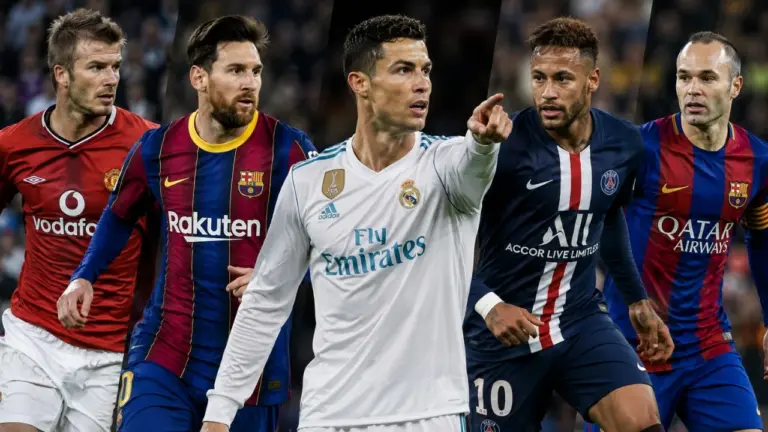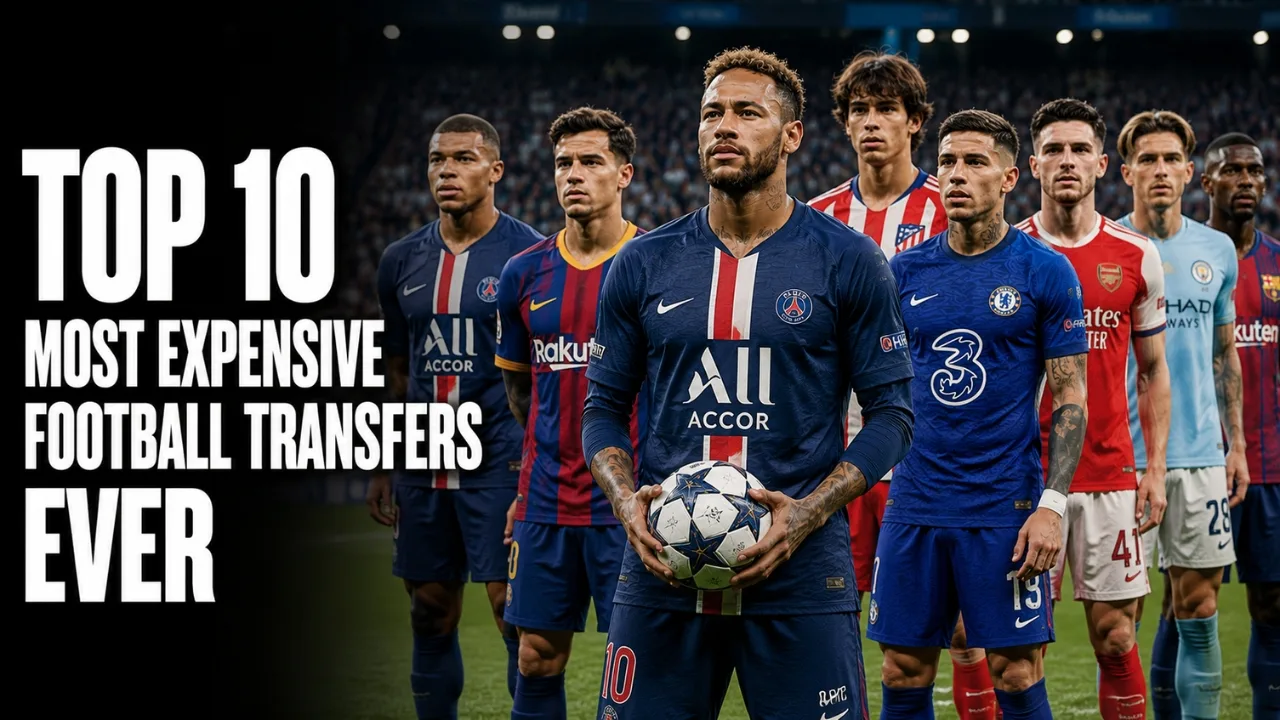
Premier League clubs have completed many of football's highest-value transfers in recent years.
Football’s transfer market has never stood still. Every few years, a blockbuster deal reshapes expectations, pushes financial boundaries, and changes the direction of clubs and players alike. From Neymar’s world-record move to Paris Saint-Germain to recent nine-figure transfers involving Premier League giants, record-breaking fees have become a defining feature of modern football. This guide ranks the most expensive transfers in football history, explains why clubs spend so heavily, and examines which deals delivered the strongest return on the pitch.
Quick Answer
As of 2026, Neymar’s €222 million transfer from Barcelona to Paris Saint-Germain in 2017 remains the most expensive football transfer in history. No officially completed transfer has surpassed that fee.
Top 10 Most Expensive Football Transfers Ever
| Rank | Player | From | To | Reported Fee | Year |
|---|---|---|---|---|---|
| 1 | Neymar | Barcelona | Paris Saint-Germain | €222 million | 2017 |
| 2 | Kylian Mbappé | Monaco | Paris Saint-Germain | €180 million | 2018 |
| 3 | Philippe Coutinho | Liverpool | Barcelona | €145 million | 2018 |
| 4 | João Félix | Benfica | Atlético Madrid | €126 million | 2019 |
| 5 | Enzo Fernández | Benfica | Chelsea | €121 million | 2023 |
| 6 | Eden Hazard | Chelsea | Real Madrid | €120.8 million* | 2019 |
| 7 | Jack Grealish | Aston Villa | Manchester City | £100 million | 2021 |
| 8 | Declan Rice | West Ham United | Arsenal | £100 million + add-ons | 2023 |
| 9 | Moisés Caicedo | Brighton & Hove Albion | Chelsea | £100 million + add-ons | 2023 |
| 10 | Ousmane Dembélé | Borussia Dortmund | Barcelona | Up to €147 million** | 2017 |
* Reported fee including achievable add-ons.
** Widely reported maximum package; guaranteed fee was lower. Figures vary slightly between official announcements and media reporting.
Why Neymar’s Transfer Still Stands Alone
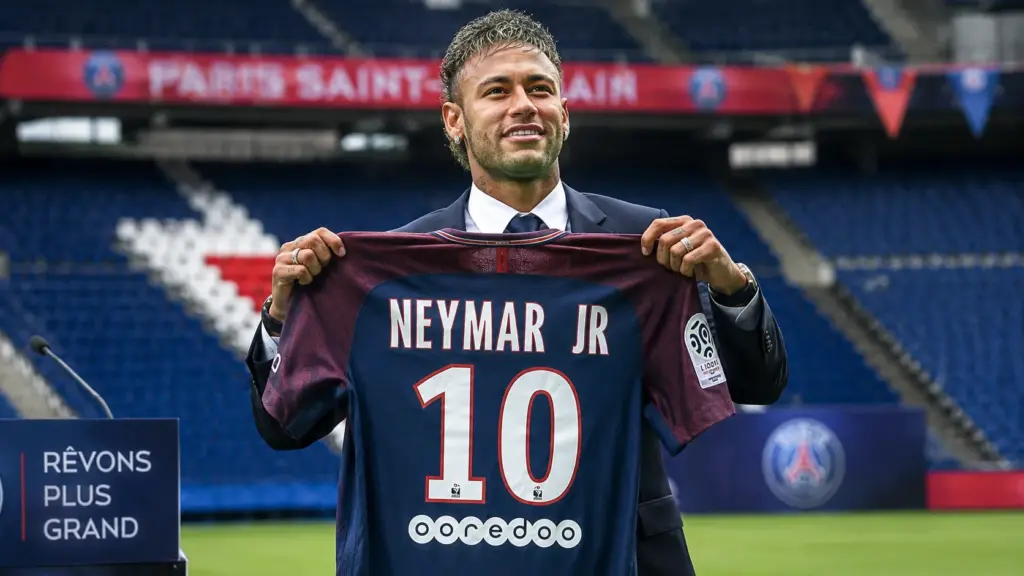
When Paris Saint-Germain activated Neymar’s €222 million release clause in August 2017, football entered a new financial era.
The transfer more than doubled the previous world-record fee and fundamentally changed how clubs valued elite players in the transfer market. It also forced many clubs to reassess player valuations, making €100 million transfers increasingly common over the following years.
Beyond the financial impact, Neymar’s arrival elevated PSG’s global profile and helped establish the French club as one of Europe’s commercial powerhouses.
Neymar’s record-breaking move also reflected the growing market for elite talent, with transfer fees increasingly influenced by the value attached to world-class players. That trend can also be seen among the most valuable football players in the world in 2026.
Biggest Premier League Transfers
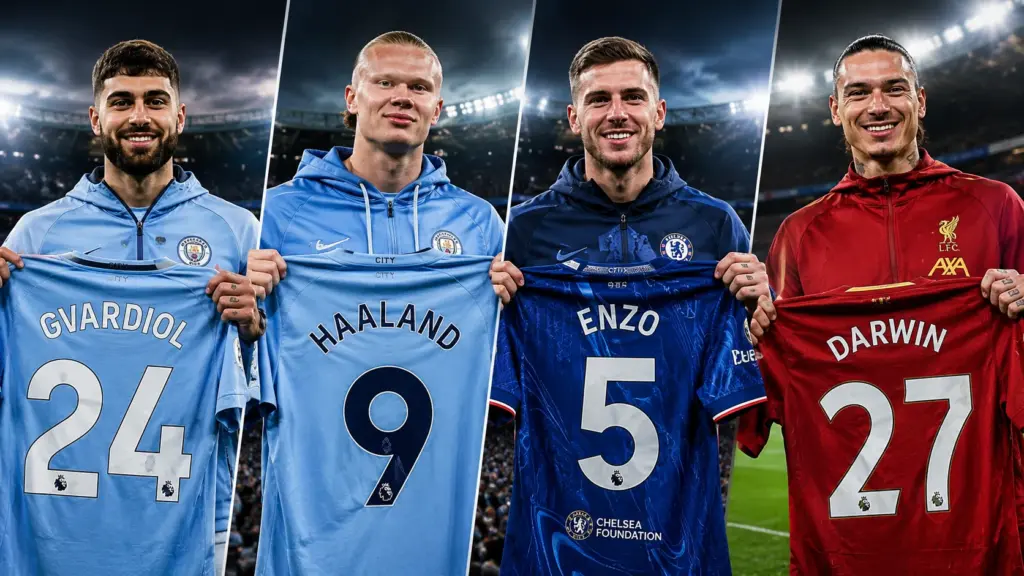
The Premier League dominates modern transfer spending, with English clubs responsible for many of football’s largest deals.
| Player | Club | Reported Fee |
|---|---|---|
| Moisés Caicedo | Chelsea | £100m + add-ons |
| Declan Rice | Arsenal | £100m + add-ons |
| Jack Grealish | Manchester City | £100 million |
| Enzo Fernández | Chelsea | €121 million |
| Romelu Lukaku | Chelsea | £97.5 million |
The league’s broadcasting revenue and commercial strength continue to give its clubs unmatched spending power in the global transfer market.
That financial advantage is one reason English football remains so competitive from season to season, helping explain why the Premier League is more unpredictable than ever.
Which Transfers Proved Worth the Money?
A record fee does not always guarantee success.
Jack Grealish – Manchester City
Although expectations were enormous following his move from Aston Villa, Grealish became an important part of Manchester City’s Treble-winning side in 2022–23. His tactical discipline and ball retention made him a valuable contributor under Pep Guardiola.
Declan Rice – Arsenal
Rice quickly established himself as one of Arsenal’s most influential midfielders. His defensive intelligence, leadership, and consistency justified the club’s significant investment.
His performances have reinforced the importance of complete midfielders in the modern game, alongside many players featured among the greatest midfielders in football history.
Enzo Fernández – Chelsea
Chelsea invested heavily after Fernández starred at the 2022 FIFA World Cup. While the club experienced mixed results initially, the Argentine international became a central figure in midfield thanks to his passing range and composure.
Transfers That Fell Short of Expectations
Not every blockbuster signing delivers immediate success.
Philippe Coutinho – Barcelona
Barcelona signed Coutinho following Neymar’s departure, but the Brazilian struggled to consistently reproduce his Liverpool form. Despite moments of quality, injuries and tactical changes limited his long-term impact.
Eden Hazard – Real Madrid
Hazard arrived in Spain as one of the world’s best attackers, yet injuries severely restricted his time at Real Madrid. His spell never matched the standards he had previously set in the Premier League.
João Félix – Atlético Madrid
João Félix showed flashes of exceptional talent but never consistently justified the record investment. Loan spells later reflected the challenges he faced in establishing himself as Atlético’s attacking centerpiece.
Why Transfer Fees Keep Increasing
Modern football has become one of the world’s biggest sports businesses, and transfer fees have grown alongside television revenue, sponsorship deals, and commercial income.
Several factors influence a player’s market value:
- Age and long-term potential
- Contract length
- Recent performances
- International experience
- Market demand
- Financial strength of the buying club
A player with multiple years remaining on his contract generally commands a much higher fee because the selling club is under little pressure to negotiate.
How Transfer Fees Actually Work
The headline fee reported after a transfer is not always the amount ultimately paid.
Many major deals include:
- Guaranteed transfer fee
- Performance-related bonuses
- Trophy-related add-ons
- Sell-on clauses
- Solidarity payments and training compensation (where applicable under FIFA regulations)
For that reason, different reputable sources sometimes report slightly different totals for the same transfer. Official club statements also do not always disclose the complete financial structure.
Currency conversions can also lead to small differences in reported transfer values, particularly when fees are originally agreed in pounds sterling or euros and later reported in another currency.
Biggest Spending Clubs in Football History
Some clubs appear repeatedly whenever transfer records are discussed.
| Club | Notable Record Signings |
|---|---|
| Paris Saint-Germain | Neymar, Kylian Mbappé |
| Chelsea | Enzo Fernández, Moisés Caicedo, Romelu Lukaku |
| Barcelona | Philippe Coutinho, Ousmane Dembélé |
| Real Madrid | Eden Hazard, Jude Bellingham* |
| Manchester City | Jack Grealish |
| Arsenal | Declan Rice |
*Jude Bellingham’s transfer included performance-related add-ons that could increase the overall package, but the guaranteed fee places him outside the all-time top tier.
Which Record Could Be Broken Next?
Neymar’s €222 million world-record transfer has stood since 2017 because very few clubs possess both the financial resources and the willingness to complete a deal of that size.
Modern financial regulations, including UEFA’s Financial Sustainability Regulations and domestic league spending controls, have encouraged clubs to manage transfer spending more carefully. While future television revenue and commercial growth could eventually produce another record-breaking transfer, no officially confirmed move has yet surpassed Neymar’s landmark deal.
Common Misconceptions About Football Transfer Fees
“The most expensive player is automatically the best player.”
Transfer fees reflect market conditions as much as footballing ability. Contract length, competition between clubs, and timing can significantly influence a player’s valuation.
“Every reported transfer fee is official.”
Many figures come from reliable media reports because clubs frequently keep financial details confidential. As a result, reported fees may differ slightly between trusted outlets.
“Add-ons are always paid.”
Not necessarily. Many bonuses depend on appearances, trophies, Champions League qualification, or individual achievements. Some clauses are activated, while others are never reached.
What Makes a Transfer Successful?
A successful transfer cannot be judged solely by goals or assists, particularly when evaluating players in different positions.
Clubs also evaluate:
- Team success
- Consistency
- Leadership
- Availability and fitness
- Tactical contribution
- Long-term resale value
Some expensive signings become club legends despite modest statistics, while others fail despite impressive individual numbers.
Key Takeaways
- Neymar’s €222 million move to Paris Saint-Germain remains the most expensive transfer in football history.
- Kylian Mbappé and Philippe Coutinho complete the top three based on widely reported transfer fees.
- Premier League clubs dominate modern transfer spending thanks to strong commercial and broadcasting revenues.
- Headline transfer fees often include performance-based bonuses and conditional add-ons.
- A record fee does not guarantee success, as several of football’s biggest transfers have produced mixed results.
Final Thoughts
Football’s biggest transfers are about far more than eye-catching numbers. They reflect a club’s ambition, financial strength, long-term planning, and belief that one player can change its future.
Many of the clubs responsible for these headline transfers have also built enduring legacies through sustained success over decades, earning places among the most successful football clubs in history.
Some record signings have transformed clubs and delivered trophies, while others struggled to justify enormous expectations. What has remained unchanged is the significance of Neymar’s 2017 move to Paris Saint-Germain, which continues to stand as the benchmark for transfer spending. Whether that record is eventually broken will depend not only on the quality of the next superstar but also on the financial landscape of modern football.
FAQ
Who is the most expensive football player ever?
Neymar remains the most expensive player in football history following his €222 million transfer from Barcelona to Paris Saint-Germain in 2017.
Which club has spent the most money on a single player?
Paris Saint-Germain holds the record after signing Neymar for €222 million.
Has any transfer surpassed Neymar’s record?
No. As of 2026, no officially completed transfer has exceeded Neymar’s €222 million move.
Why do transfer fees vary between different websites?
Many clubs do not publish complete financial details. Trusted media outlets may report different figures depending on whether bonuses and add-ons are included.
What is the difference between a guaranteed fee and add-ons?
A guaranteed fee is paid regardless of future events, while add-ons are conditional payments linked to performance, appearances, trophies, or other agreed milestones.
Are transfer fees paid in one installment?
Not always. Large transfers are commonly structured across multiple scheduled payments, although the exact terms are usually confidential.
Sources
- FootballTransfers – Historical Transfer Fee Database
- FIFA – Regulations on the Status and Transfer of Players
- UEFA – Financial Sustainability Regulations
- Premier League – Official Player Registration Announcements
- La Liga – Official Competition Information
- BBC Sport
- Reuters
- ESPN
- Sky Sports
- The Athletic
About the Author