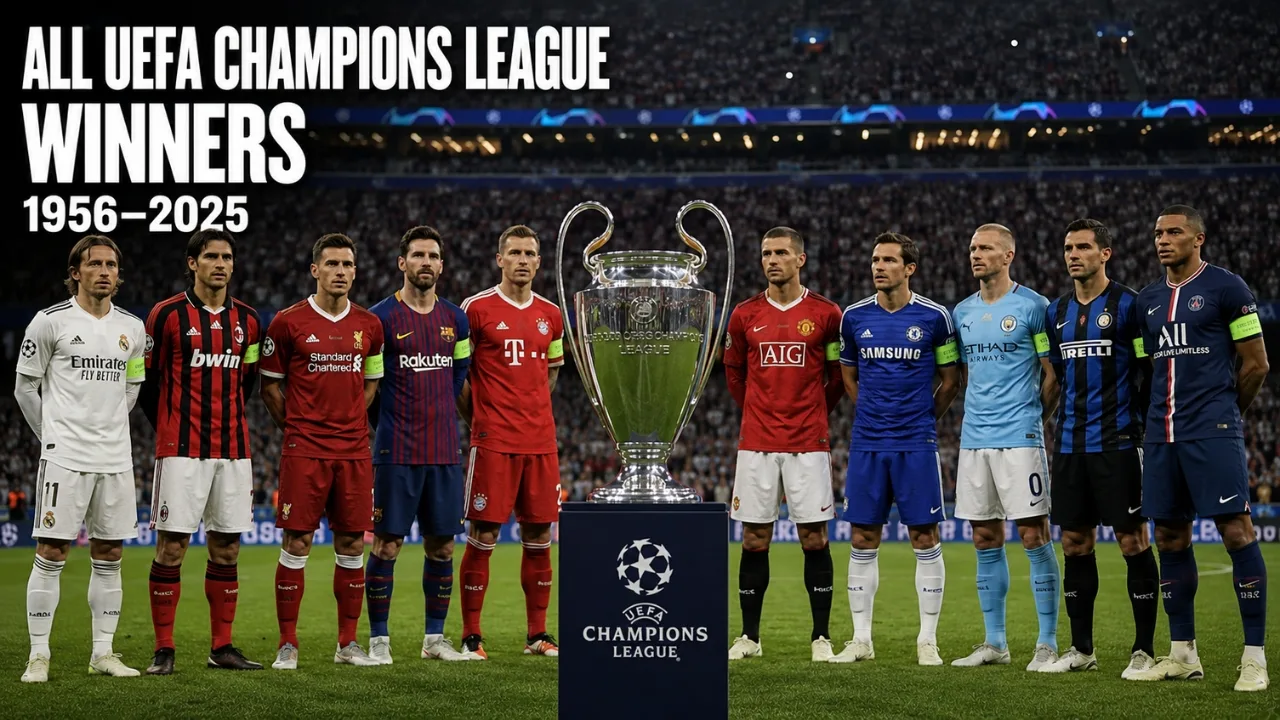
The complete UEFA Champions League winners list from 1956 to 2025 featuring every European champion and final result.
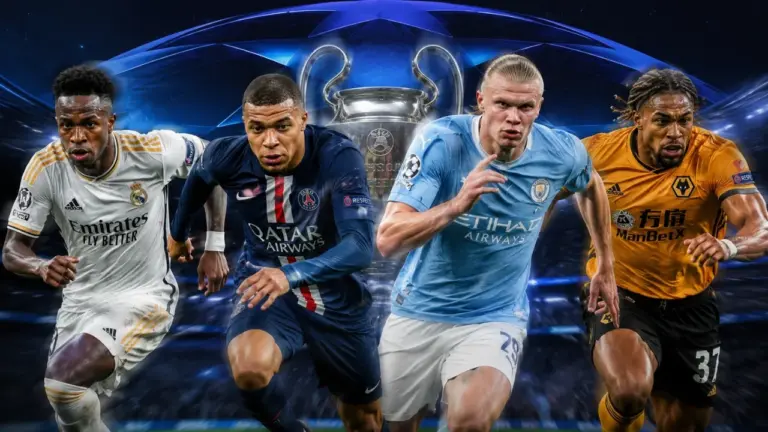
The UEFA Champions League has long been regarded as the pinnacle of European club football. Since its inaugural season in 1955–56 as the European Champion Clubs’ Cup, the competition has produced unforgettable finals, legendary teams, and some of the greatest players in football history. From Real Madrid’s dominance in the early years to modern triumphs by Manchester City and Paris Saint-Germain, the tournament continues to define club greatness.
This guide provides a complete UEFA Champions League winners list from 1956 through 2025, along with key records, historical context, and the clubs that have shaped Europe’s premier club competition.
Quick Answer
| Category | Details |
|---|---|
| Competition | UEFA Champions League (formerly European Cup) |
| Founded | 1955 |
| First Champion | Real Madrid (1956) |
| Most Successful Club | Real Madrid |
| Current Format | League phase followed by knockout rounds |
| Governing Body | UEFA |
Complete UEFA Champions League Winners List (1956–2025)
| Season | Winner | Runner-up | Final Score |
|---|---|---|---|
| 1955–56 | Real Madrid | Stade de Reims | 4–3 |
| 1956–57 | Real Madrid | Fiorentina | 2–0 |
| 1957–58 | Real Madrid | AC Milan | 3–2 (AET) |
| 1958–59 | Real Madrid | Stade de Reims | 2–0 |
| 1959–60 | Real Madrid | Eintracht Frankfurt | 7–3 |
| 1960–61 | Benfica | Barcelona | 3–2 |
| 1961–62 | Benfica | Real Madrid | 5–3 |
| 1962–63 | AC Milan | Benfica | 2–1 |
| 1963–64 | Inter Milan | Real Madrid | 3–1 |
| 1964–65 | Inter Milan | Benfica | 1–0 |
| 1965–66 | Real Madrid | Partizan | 2–1 |
| 1966–67 | Celtic | Inter Milan | 2–1 |
| 1967–68 | Manchester United | Benfica | 4–1 (AET) |
| 1968–69 | AC Milan | Ajax | 4–1 |
| 1969–70 | Feyenoord | Celtic | 2–1 (AET) |
| 1970–71 | Ajax | Panathinaikos | 2–0 |
| 1971–72 | Ajax | Inter Milan | 2–0 |
| 1972–73 | Ajax | Juventus | 1–0 |
| 1973–74 | Bayern Munich | Atlético Madrid | 1–1, Replay 4–0 |
| 1974–75 | Bayern Munich | Leeds United | 2–0 |
| 1975–76 | Bayern Munich | Saint-Étienne | 1–0 |
| 1976–77 | Liverpool | Borussia Mönchengladbach | 3–1 |
| 1977–78 | Liverpool | Club Brugge | 1–0 |
| 1978–79 | Nottingham Forest | Malmö FF | 1–0 |
| 1979–80 | Nottingham Forest | Hamburg | 1–0 |
| 1980–81 | Liverpool | Real Madrid | 1–0 |
| 1981–82 | Aston Villa | Bayern Munich | 1–0 |
| 1982–83 | Hamburg | Juventus | 1–0 |
| 1983–84 | Liverpool | Roma | 1–1 (Liverpool won on penalties) |
| 1984–85 | Juventus | Liverpool | 1–0 |
| 1985–86 | Steaua București | Barcelona | 0–0 (Steaua won on penalties) |
| 1986–87 | Porto | Bayern Munich | 2–1 |
| 1987–88 | PSV Eindhoven | Benfica | 0–0 (PSV won on penalties) |
| 1988–89 | AC Milan | Steaua București | 4–0 |
| 1989–90 | AC Milan | Benfica | 1–0 |
| 1990–91 | Red Star Belgrade | Marseille | 0–0 (Red Star won on penalties) |
| 1991–92 | Barcelona | Sampdoria | 1–0 (AET) |
| 1992–93 | Marseille | AC Milan | 1–0 |
| 1993–94 | AC Milan | Barcelona | 4–0 |
| 1994–95 | Ajax | AC Milan | 1–0 |
| 1995–96 | Juventus | Ajax | 1–1 (Juventus won on penalties) |
| 1996–97 | Borussia Dortmund | Juventus | 3–1 |
| 1997–98 | Real Madrid | Juventus | 1–0 |
| 1998–99 | Manchester United | Bayern Munich | 2–1 |
| 1999–2000 | Real Madrid | Valencia | 3–0 |
| 2000–01 | Bayern Munich | Valencia | 1–1 (Bayern won on penalties) |
| 2001–02 | Real Madrid | Bayer Leverkusen | 2–1 |
| 2002–03 | AC Milan | Juventus | 0–0 (AC Milan won on penalties) |
| 2003–04 | Porto | Monaco | 3–0 |
| 2004–05 | Liverpool | AC Milan | 3–3 (Liverpool won on penalties) |
| 2005–06 | Barcelona | Arsenal | 2–1 |
| 2006–07 | AC Milan | Liverpool | 2–1 |
| 2007–08 | Manchester United | Chelsea | 1–1 (Manchester United won on penalties) |
| 2008–09 | Barcelona | Manchester United | 2–0 |
| 2009–10 | Inter Milan | Bayern Munich | 2–0 |
| 2010–11 | Barcelona | Manchester United | 3–1 |
| 2011–12 | Chelsea | Bayern Munich | 1–1 (Chelsea won on penalties) |
| 2012–13 | Bayern Munich | Borussia Dortmund | 2–1 |
| 2013–14 | Real Madrid | Atlético Madrid | 4–1 (AET) |
| 2014–15 | Barcelona | Juventus | 3–1 |
| 2015–16 | Real Madrid | Atlético Madrid | 1–1 (Real Madrid won on penalties) |
| 2016–17 | Real Madrid | Juventus | 4–1 |
| 2017–18 | Real Madrid | Liverpool | 3–1 |
| 2018–19 | Liverpool | Tottenham Hotspur | 2–0 |
| 2019–20 | Bayern Munich | Paris Saint-Germain | 1–0 |
| 2020–21 | Chelsea | Manchester City | 1–0 |
| 2021–22 | Real Madrid | Liverpool | 1–0 |
| 2022–23 | Manchester City | Inter Milan | 1–0 |
| 2023–24 | Real Madrid | Borussia Dortmund | 2–0 |
| 2024–25 | Paris Saint-Germain | Inter Milan | 5–0 |
The Evolution from European Cup to Champions League
The competition began in 1955 as the European Champion Clubs’ Cup, featuring only domestic league champions from across Europe. In 1992, UEFA introduced the Champions League branding alongside a group-stage format that transformed the tournament into one of the world’s most prestigious annual sporting events.
Over the following decades, the competition expanded to include multiple clubs from Europe’s highest-ranked domestic leagues, raising both its competitive standard and worldwide popularity.
Clubs with the Most UEFA Champions League Titles
| Club | Titles |
|---|---|
| Real Madrid | 16 |
| AC Milan | 7 |
| Bayern Munich | 6 |
| Liverpool | 6 |
| Barcelona | 5 |
| Ajax | 4 |
| Inter Milan | 3 |
| Manchester United | 3 |
| Benfica | 2 |
| Juventus | 2 |
| Chelsea | 2 |
| Nottingham Forest | 2 |
| Porto | 2 |
Real Madrid remains comfortably the competition’s most successful club, extending its record with victories in 2022 and 2024 before Paris Saint-Germain captured their first European Cup in 2025.
That remarkable European record is one of the biggest reasons Real Madrid consistently rank among the most successful football clubs in history, with sustained dominance across both domestic and international competitions.
Dynasties That Defined European Football
Real Madrid’s Historic Beginning
Real Madrid won the first five European Cups between 1956 and 1960, establishing a standard that no club has matched over such a sustained period at the competition’s birth. Led by legends including Alfredo Di Stéfano and Ferenc Puskás, they laid the foundation for the club’s enduring European legacy.
Ajax and Total Football
Ajax dominated the early 1970s by winning three consecutive European Cups under the influence of Total Football. Johan Cruyff became the symbol of a tactical revolution that changed football worldwide.
Cruyff’s influence extended far beyond Ajax, inspiring generations of players and coaches while cementing his place among the greatest football players ever to influence the game.
AC Milan’s Golden Eras
From the late 1980s into the early 1990s, AC Milan produced one of Europe’s greatest club sides, while another Champions League triumph arrived in 2003 before the club added its seventh title in 2007.
Modern Champions League Era
The UEFA Champions League has continued to evolve since the turn of the century, with tactical innovation, increased financial investment, and global broadcasting transforming it into football’s premier club competition.
Real Madrid’s Recent Dominance
No club has defined the modern Champions League quite like Real Madrid.
Between 2014 and 2024, Los Blancos won six European titles, including an unprecedented three consecutive Champions League trophies from 2016 to 2018 under Zinedine Zidane. Victories over Atlético Madrid, Juventus, Liverpool, and Borussia Dortmund further strengthened the club’s reputation as Europe’s greatest tournament team.
Manchester City’s Breakthrough
After years of coming close, Manchester City finally lifted their first UEFA Champions League trophy in 2023 by defeating Inter Milan 1-0 in Istanbul.
The victory completed a historic continental treble and marked Manchester City’s first European Cup triumph.
Paris Saint-Germain’s Historic First Title
The 2024-25 season produced another milestone in European football history.
Paris Saint-Germain secured the club’s first European Cup by defeating Inter Milan 5-0 in the final in Munich. It was also the biggest winning margin ever recorded in a Champions League final, giving PSG their long-awaited breakthrough on Europe’s biggest stage.
Which Countries Have Won the Most European Cups?
Success in the Champions League has largely been concentrated among clubs from Europe’s traditional football powers.
| Country | European Cup / Champions League Titles* |
|---|---|
| Spain | 21 |
| England | 16 |
| Italy | 13 |
| Germany | 8 |
| Netherlands | 6 |
| Portugal | 4 |
| France | 2 |
| Romania | 1 |
| Serbia (including Yugoslav clubs) | 1 |
| Scotland | 1 |
*Titles counted through the 2024-25 season.
Spain’s remarkable record is driven primarily by Real Madrid and Barcelona, while England’s success has been shared among several clubs including Liverpool, Manchester United, Chelsea, Nottingham Forest, Aston Villa, and Manchester City.
The distribution of titles also highlights how success has shifted between different footballing nations as tactical trends, financial investment, and qualification formats have evolved.
Memorable Champions League Finals
Some finals have become defining moments in football history.
Real Madrid 7-3 Eintracht Frankfurt (1960)
Widely considered one of the greatest club matches ever played, Alfredo Di Stéfano and Ferenc Puskás inspired Real Madrid to a spectacular victory at Hampden Park.
Manchester United 2-1 Bayern Munich (1999)
Two stoppage-time goals completed one of football’s greatest comebacks, securing Manchester United’s historic continental treble.
Liverpool 3-3 AC Milan (2005)
Known simply as the “Miracle of Istanbul,” Liverpool recovered from a 3-0 halftime deficit before winning on penalties in one of the most dramatic finals ever played.
Chelsea 1-1 Bayern Munich (2012)
Playing in Bayern Munich’s home stadium, Chelsea equalized late through Didier Drogba before winning the club’s first Champions League title on penalties.
Manchester City 1-0 Inter Milan (2023)
Rodri’s decisive goal finally delivered the European title that Manchester City had pursued for more than a decade.
Players Who Have Defined the Competition
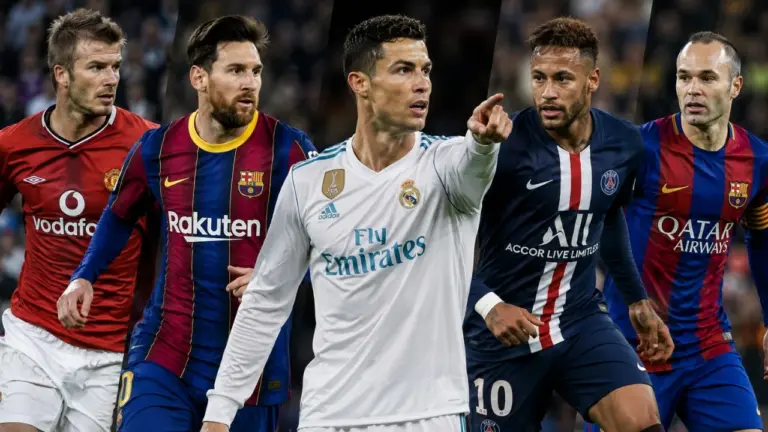
While the Champions League is ultimately a team competition, several players have shaped its history through extraordinary performances.
- Cristiano Ronaldo remains the competition’s all-time leading goalscorer.
- Lionel Messi produced countless memorable moments while winning four Champions League titles with Barcelona.
- Paco Gento holds the record for the most European Cup titles won by a player with six, all for Real Madrid.
- Luka Modrić, Karim Benzema, Toni Kroos, Dani Carvajal, and Nacho were central figures in Real Madrid’s modern era of dominance.
His extraordinary Champions League record complements an even broader legacy, with Ronaldo also featuring at the top of the list of football players with the most goals in history.
Common Misconceptions
The European Cup and Champions League are different competitions.
Not exactly.
The UEFA Champions League is the direct continuation of the European Cup. Although the name changed in 1992 and the format expanded, all previous winners remain part of the same official competition history recognized by UEFA.
Only league champions can qualify.
That was true for much of the competition’s early history.
Today, multiple clubs from Europe’s highest-ranked domestic leagues qualify based on league position under UEFA’s qualification system.
Winning the Champions League guarantees next season’s domestic title.
Success in Europe does not automatically translate into domestic dominance. Many Champions League winners have faced difficult league campaigns the following season because of fixture congestion, squad rotation, and increased expectations.
Key Takeaways
- The competition began in 1955 as the European Cup.
- Real Madrid won the first five editions and remain the most successful club with 16 titles.
- The tournament became the UEFA Champions League in 1992.
- AC Milan, Bayern Munich, Liverpool, Barcelona, and Real Madrid are among the most successful clubs in competition history.
- Paris Saint-Germain became first-time European champions in 2025.
- The Champions League remains the highest level of club football in Europe.
Final Thoughts
Few sporting competitions match the prestige, history, and emotional significance of the UEFA Champions League. Every season adds another chapter to a tournament that has showcased legendary clubs, iconic players, and unforgettable finals for nearly seven decades.
From Real Madrid’s dominance in the 1950s to Paris Saint-Germain’s breakthrough in 2025, the Champions League winners list reflects the evolution of European football itself. While records continue to be challenged, lifting the famous trophy remains the ultimate achievement in club football.
FAQ
Which club has won the most UEFA Champions League titles?
Real Madrid are the competition’s most successful club with 16 European Cup/Champions League titles through the 2024-25 season.
Who won the first European Cup?
Real Madrid won the inaugural European Cup in 1956 after defeating Stade de Reims 4-3.
When did the European Cup become the UEFA Champions League?
UEFA officially rebranded the competition as the UEFA Champions League for the 1992-93 season.
Which club won the 2025 UEFA Champions League?
Paris Saint-Germain won the 2024-25 UEFA Champions League, defeating Inter Milan 5-0 in the final.
Has any club won five consecutive European Cups?
Yes. Real Madrid won the first five consecutive European Cups from 1956 through 1960, a record that still stands.
Which country has produced the most Champions League winners?
Spanish clubs have won the most European Cup/Champions League titles, led by Real Madrid and Barcelona.
Sources
- AP News
- UEFA – Official UEFA Champions League History
- UEFA Champions League Finals Archive
- FIFA
- RSSSF (Rec.Sport.Soccer Statistics Foundation)
- Reuters
- BBC Sport
- ESPN
About the Author