Kylian Mbappé, Achraf Hakimi, Alphonso Davies, and other elite speedsters continue to redefine pace in modern football.
Speed remains one of football’s most valuable weapons. Tactical systems continue to evolve, pressing structures become more sophisticated, and defensive lines push higher up the pitch, yet elite pace can still change a match in seconds. In 2026, some of the world’s biggest stars continue to rely on explosive acceleration and top-end speed to separate themselves from opponents. This guide examines the fastest active footballers in 2026 based on officially recorded sprint data, league tracking systems, and widely reported performance metrics.
Quick Answer
If you’re looking for the fastest footballers still playing at the highest level in 2026, Kylian Mbappé remains the leading name. However, defenders such as Micky van de Ven and Achraf Hakimi have also recorded extraordinary sprint speeds in recent seasons.
Speed records continue to spark debate among fans because different competitions measure sprint data differently. For a broader look at the biggest pace achievements ever recorded, see our ranking of the fastest football players of all time.
How Football Speed Is Measured
Modern football uses advanced tracking technology installed inside stadiums.
These systems record:
- Maximum sprint speed
- Acceleration rates
- Distance covered
- High-intensity runs
- Repeated sprint actions
Because different competitions use different tracking providers, exact speed rankings can vary slightly. For that reason, this article focuses on widely reported official speed records rather than unofficial estimates.
Reported sprint speeds can vary depending on the competition, tracking technology, and measurement methodology used. Where multiple figures exist, the most widely cited official data has been prioritized.
Fastest Active Footballers in 2026
| Player | Club (2026) | Position | Reported Top Speed |
|---|---|---|---|
| Kylian Mbappé | Real Madrid | Forward | Around 38.0 km/h |
| Micky van de Ven | Tottenham Hotspur | Defender | 37.38 km/h |
| Kyle Walker | Active Professional | Defender | 37.31 km/h |
| Achraf Hakimi | Paris Saint-Germain | Defender | Above 37 km/h |
| Karim Adeyemi | Borussia Dortmund | Forward | Around 37.6 km/h |
| Alphonso Davies | Bayern Munich | Defender | Above 36 km/h |
| Erling Haaland | Manchester City | Forward | 36.9 km/h |
| Rafael Leão | AC Milan | Forward | Around 36.5 km/h |
| Nico Williams | Athletic Club | Winger | Around 35.9 km/h |
| Vinícius Júnior | Real Madrid | Forward | Above 35 km/h |
The table reflects reported top speeds from official league tracking systems, competition data, and widely cited performance records.
1. Kylian Mbappé (Real Madrid)
Why He Remains the Speed King
Few players combine acceleration and technical quality as effectively as Mbappé.
His ability to reach maximum speed while maintaining close control makes him especially dangerous in transition. Multiple reports continue to place him near the top of football’s speed rankings, with recorded sprint speeds around 38 km/h.
Mbappé has repeatedly recorded sprint speeds approaching 38 km/h in official tracking data, reinforcing his reputation as one of football’s fastest athletes.
What Makes Him Different
Many fast players can win races in open space.
Mbappé’s advantage comes from how quickly he reaches top speed. Defenders often lose ground within the first few strides, making recovery extremely difficult.
2. Micky van de Ven (Tottenham Hotspur)
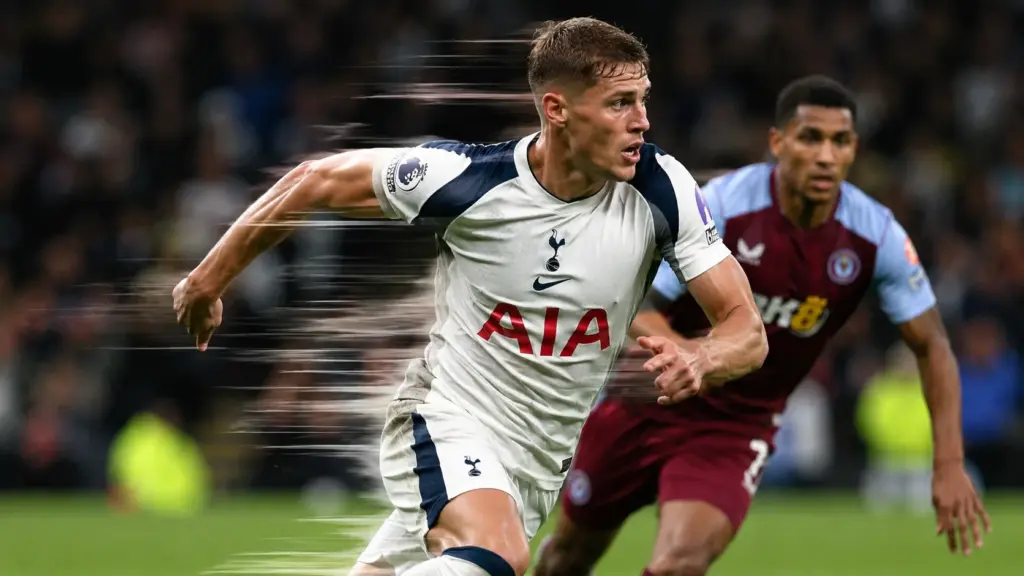
The Dutch defender has become one of the most notable names among football’s fastest players.
While center-backs are rarely associated with sprint records, Van de Ven has repeatedly produced remarkable numbers. The Premier League officially recorded him at 37.38 km/h, making him one of the fastest players ever measured in the competition.
Premier League tracking systems have transformed how player speed is measured, allowing direct comparisons with some of the fastest Premier League players in history recorded over the years.
Why His Pace Matters
Modern defenders frequently defend large spaces behind high defensive lines.
Van de Ven’s recovery speed allows Tottenham to play aggressively without exposing themselves to counterattacks.
3. Achraf Hakimi (Paris Saint-Germain)
Hakimi has built much of his career around exceptional athleticism and recovery speed.
Whether playing as a full-back or wing-back, he consistently ranks among football’s quickest players. Multiple speed analyses place him comfortably above 36 km/h, with some reports showing speeds exceeding 37 km/h.
Hakimi’s pace is especially valuable in European competition, where transitional football often decides matches. His profile is comparable to several names featured among the fastest Champions League players ever ranked.
Attacking Threat
Unlike many defenders, Hakimi uses his pace as an attacking weapon.
His overlapping runs stretch defenses and create additional width in possession.
4. Karim Adeyemi (Borussia Dortmund)
Adeyemi remains one of the Bundesliga’s most explosive attackers.
His speed in transition makes him particularly effective against teams that commit numbers forward. Reported top-speed data continues to place him among football’s quickest active players.
5. Kyle Walker
Even in the later stages of his career, Walker’s pace remains remarkable.
The English defender has previously recorded speeds above 37 km/h and remains widely regarded as one of the fastest defenders of his generation.
Longevity Through Athleticism
Walker’s speed has been central to his success for more than a decade, helping him defend against elite wingers across both domestic and international football.
6. Alphonso Davies (Bayern Munich)
Davies remains football’s benchmark for explosive runs from deep positions.
The Canadian international combines long-stride acceleration with excellent dribbling ability, allowing him to carry the ball over large distances while maintaining control. Reports continue to place him among the sport’s fastest active players.
Why Speed Matters More Than Ever
Modern football places enormous physical demands on players.
High pressing, transitional attacks, and defensive recovery runs require athletes capable of covering ground quickly. Speed alone does not guarantee success, but when combined with technical quality, positioning, and tactical intelligence, it becomes one of the game’s most valuable advantages.
7. Erling Haaland (Manchester City)
Haaland’s physical profile continues to make him one of football’s most unique athletes.
Standing over 6 feet 4 inches tall, he combines elite strength with remarkable speed. Premier League tracking data has previously recorded him at speeds approaching 37 km/h, numbers typically associated with smaller attacking players rather than powerful center-forwards.
Haaland’s combination of pace and finishing ability is rare for a center-forward, which is why discussions about elite attacking speed often include many of the fastest strikers in football history.
Why Defenders Struggle Against Him
Most defenders are accustomed to facing either strength or speed.
Haaland offers both. His ability to accelerate into space while maintaining physical dominance makes him one of the most difficult forwards to contain in world football.
8. Rafael Leão (AC Milan)
Leão remains one of Serie A’s most dangerous transition players.
The Portuguese international uses his pace to attack defenders in one-on-one situations and create separation over long distances. His ability to carry the ball at speed has become a defining feature of Milan’s attacking play.
More Than Just Pace
Leão’s effectiveness comes from combining speed with dribbling ability, creativity, and composure in the final third.
That combination makes him significantly more dangerous than players who rely solely on athleticism.
9. Nico Williams (Athletic Club)
Williams has developed into one of Europe’s most exciting wide players.
His acceleration allows him to beat defenders on either flank, while his direct style creates constant problems for opposing full-backs.
Strong performances for both Athletic Club and Spain have increased his reputation as one of football’s premier speed merchants.
A Perfect Modern Winger
Modern wide attackers must do more than simply run fast.
Today’s elite wide players are expected to combine pace with pressing, creativity, and end product. Many of the game’s most explosive flank players also appear in our ranking of the fastest wingers in football history.
Williams contributes through pressing, chance creation, and intelligent movement while still maintaining elite-level pace.
10. Vinícius Júnior (Real Madrid)
Vinícius continues to be among the world’s most feared attacking players.
His speed over both short and long distances makes him a constant threat on counterattacks. Opponents often attempt to double-team him, yet his acceleration frequently allows him to escape pressure.
Why His Pace Is So Effective
Vinícius rarely reaches top speed in straight-line sprints alone.
Instead, he changes direction quickly while maintaining momentum, making him especially difficult to defend in tight spaces.
Speed vs Acceleration: What’s the Difference?
Many fans use speed and acceleration interchangeably, but football analysts view them differently.
| Attribute | Meaning |
|---|---|
| Top Speed | Maximum velocity a player can reach |
| Acceleration | How quickly a player reaches that speed |
| Agility | Ability to change direction efficiently |
| Explosiveness | Combination of acceleration and power |
A player may record a higher top speed than Mbappé in isolated situations, but few can match his acceleration during match conditions.
This distinction helps explain why some players appear faster than others despite similar sprint numbers.
Common Misconceptions About Football Speed
The Fastest Player Isn’t Always the Best Player
Raw pace is valuable, but football remains a technical and tactical sport.
Players who combine speed with positioning, decision-making, and ball control generally achieve greater success.
Sprint Records Don’t Tell the Whole Story
A single recorded sprint may happen under ideal conditions.
What matters more is a player’s ability to repeatedly perform high-speed actions throughout an entire match.
Defenders Can Be Among the Fastest Players
Recent tracking data has shown defenders such as Micky van de Ven, Kyle Walker, and Achraf Hakimi producing sprint speeds comparable to elite attackers.
This trend reflects how modern football increasingly values athletic defenders capable of recovering quickly and covering large spaces in transition.
Honorable Mentions
Several other active players deserve recognition for their pace:
- Jeremie Frimpong
- Ousmane Dembélé
- Mohamed Salah
- Luis Díaz
- Mykhailo Mudryk
- Marcus Rashford
- Khvicha Kvaratskhelia
While official rankings vary by competition and season, these players consistently rank among football’s quickest athletes.
Key Takeaways
- Kylian Mbappé remains widely regarded as the fastest active footballer in 2026.
- Micky van de Ven holds one of the highest officially recorded Premier League sprint speeds.
- Achraf Hakimi, Alphonso Davies, and Karim Adeyemi continue to rank among football’s quickest players.
- Erling Haaland combines elite speed with unusual physical power.
- Speed measurements vary depending on league tracking systems and competition providers.
- Acceleration is often more important than pure top speed during matches.
Final Thoughts
Football’s fastest players continue to shape matches in ways statistics alone cannot fully capture.
A well-timed sprint can break a defensive line, create a scoring chance, or prevent a goal at the opposite end of the pitch. While tracking technology now allows fans to measure speed more accurately than ever, the most effective players are those who know when and how to use their athletic gifts.
As of 2026, Kylian Mbappé remains the standard against which every other speedster is judged. Yet defenders like Micky van de Ven and Achraf Hakimi have shown that elite pace is no longer reserved for attackers. The modern game rewards speed across every position, and the players on this list continue to prove why.
FAQ
Who is the fastest football player in 2026?
Based on widely reported official sprint data, Kylian Mbappé remains the fastest active football player in 2026, with recorded speeds approaching 38 km/h.
What is the fastest officially recorded speed in recent football seasons?
Premier League records show Micky van de Ven reaching 37.38 km/h, one of the fastest officially documented speeds in league history.
Is Kylian Mbappé faster than Erling Haaland?
Yes. While Haaland is exceptionally quick for a striker, official speed data generally places Mbappé ahead in terms of top sprint speed and acceleration.
Which defender is considered the fastest in football?
Micky van de Ven and Achraf Hakimi are frequently cited among the fastest defenders currently active in professional football.
Does speed guarantee success in football?
No. Speed is a major advantage, but technical skill, decision-making, positioning, and tactical understanding remain equally important.
Sources Used
- Manchester City Official Player Profiles
- Premier League Official Tracking Data
- Professional Football Scouts Association (PFSA)
- UEFA Competition Data
- FIFA Performance Analysis Reports
- Reuters
- ESPN FC
- Runner’s World Football Speed Analysis
- Bundesliga Performance Tracking Data
- La Liga Match Performance Data
- Athletic Club Official Player Profiles
- Real Madrid Official Player Profiles
- Bayern Munich Official Player Profiles
- Paris Saint-Germain Official Player Profiles
About the Author